

Tips
Archery Game Tips: Master Angle, Power and Wind to Hit Every Target
Archery game tips for pull-back bow games: balancing angle and power, judging distance, correcting for wind, moving targets and winning archery duels.
By GamesYap Team6 min read
Pull-back archery games feel easy for the first few shots and then suddenly the arrows start landing short, long or wide. The fix is a simple, repeatable way of adjusting your aim. These archery game tips explain how angle and power work together, how to correct for wind and distance, and how to win turn-based duels, using Stickbow Showdown, our free cartoon archery game, as the example.
How a pull-back shot works
In most side-view archery games you drag back from the archer like a slingshot. Two things are decided by that drag:
- Angle: the direction of your pull sets how high the bow points.
- Power: the length of your pull sets how fast the arrow leaves the bow.
Once released, the arrow follows an arc: it rises, slows, then falls under gravity. Wind, if the game has it, nudges the arrow sideways along its flight. Every hit or miss is a combination of these few forces, which means every miss tells you something.
Change one thing at a time
The most common beginner mistake is changing both angle and power after a miss. You then have no idea which change helped.
- Pick a comfortable angle for the distance, somewhere between low and medium for most shots.
- Shoot and watch where the arrow lands.
- Adjust only power if it went short or long.
- Keep the same angle until the distance is right, then fine-tune.
This "lock the angle, tune the power" method turns guesswork into a quick, reliable routine. Many good players also remember the drag length that worked for a given distance and reuse it.
Flat shot or high arc?
| Shot type | Strengths | Weaknesses |
|---|---|---|
| Flat and powerful | Short flight time, less wind drift | Small mistakes in angle miss high or low |
| High arc | Clears obstacles and towers | Long flight time, wind has more effect |
On calm days, a flatter shot is usually easier to control. When something stands in the way, or you need to drop an arrow onto a raised target, switch to an arc.
Reading the wind
Wind is what separates casual shots from expert ones, and most advanced archery game tips are really about wind.
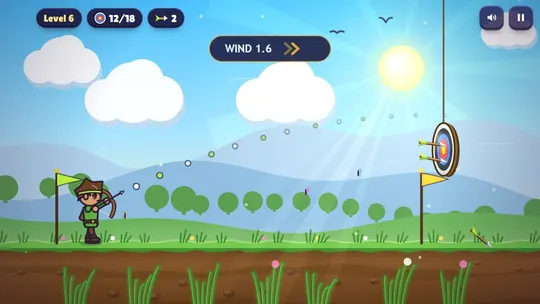
- Check the strength and direction before every shot. In many games the wind changes between shots.
- Wind behind you (blowing towards the target) carries the arrow further, so use less power.
- Wind against you shortens the shot, so add power or raise the angle a little.
- Longer flights drift more. A high, slow arc spends more time in the air, so strong wind affects it more than a fast, flat shot.
- Trust the guide if there is one. Some games show a dotted path that already includes the wind's push.
Distance and moving targets
- Far targets need either more power or a higher angle. Adding power usually keeps the shot more accurate than steepening the arc.
- Moving targets need a lead: aim where the target will be when the arrow arrives, not where it is now. Watch one full movement cycle first.
- Swinging objects are easiest to hit at the end of a swing, where they slow down before turning back.
- Small targets such as balloons reward patience. Take a moment to steady your pull before releasing.
Winning archery duels
Turn-based archery duels add a rival who shoots back. A few habits help:
- Find your range on the first shot. Even a near miss teaches you the power you need for the rest of the duel.
- Aim for the head when your range is good. In many duel games, headshots are worth the most.
- Body shots are the safe option when the wind is strong or you are unsure of the distance.
- Don't rush. In a turn-based duel, there is no penalty for taking a breath before you release.
Applying these archery game tips in Stickbow Showdown
Stickbow Showdown has a 30-level tournament path through sunny meadows, orchards, a windy canyon, a lantern-lit night and the snowy Frostpeak Summit. Here is how its real mechanics match the advice above.
- Aiming. Drag back from anywhere on the screen and release to shoot; the direction sets the angle and the length sets the power, shown by a ring at your finger. On a keyboard, Up and Down raise or lower the bow, Left and Right change power, and Space shoots.
- The guide. A dotted guide shows the arc, wind included. On the first two levels it shows the whole flight and where the arrow lands, which is perfect for learning how power and angle feel.
- Wind. A gauge at the top, plus flags and streaks in the sky, shows the wind. It pushes every arrow and changes between shots.
- Level types. Target levels ask you to reach a ring score (rings are worth 10, 8, 6, 4 and 2). Balloon and apple levels ask you to pop every one before your arrows run out. On Frostpeak Summit, you ring swinging bronze bells; arrows bounce off, so each arrow rings one bell.
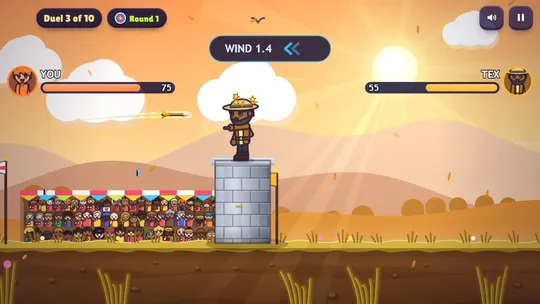
- Duels. Take turns with one of 10 named rival archers, from Pip the Rookie to Queen Aurora, the Champion, and Grand Sage Orrin at the summit. A headshot (45) does more than a body hit (25) or a leg hit (15), and it knocks the rival's hat off. It is all cartoon bonks: arrows bounce off and hats fly.
Stars
Target levels award stars by score, balloon levels by arrows left, and duels by how much health you keep. If you run out of arrows or lose a duel, you can restart the level for free.
Archery and mini golf share the same drag-and-release feel, so our mini golf tips and Putt Paradise are a natural next step. For more aiming challenges, see our shooting games.
FAQ
How do you aim better in archery games?
Change one thing at a time. Keep the same angle and adjust only the power until the arrow reaches the right distance, then fine-tune. Watch where every arrow lands, because each miss tells you whether you need more or less power. Check the wind before every shot, and use any aiming guide the game gives you while you learn.
How does wind affect arrows in archery games?
Wind pushes the arrow while it flies. A wind blowing towards the target carries the arrow further, so you need less power, while a wind blowing back at you shortens the shot. The longer the arrow is in the air, the more the wind moves it, so high arcing shots drift more than fast, flat ones.
Should you shoot high or flat in an archery game?
Shoot flat when the path is clear and the wind is light, because a fast, flat arrow spends less time in the air and is easier to control. Use a higher arc when you need to clear an obstacle or reach a raised target. In strong wind, flatter shots are usually more predictable.
How do you hit a moving target with a bow?
Aim ahead of the target, at the spot it will reach when your arrow arrives. Watch one full cycle of its movement first to learn the rhythm. Swinging targets are easiest to hit near the end of their swing, where they slow down. Release at the same point in the cycle each time so your timing stays consistent.
How many levels are in Stickbow Showdown?
Stickbow Showdown has 30 levels on a tournament path across five areas: sunny meadows, orchards, a windy canyon, a lantern-lit night and the snowy Frostpeak Summit. Levels mix ring targets, balloons, apples, swinging bells and duels against 10 named rival archers, with Grand Sage Orrin waiting at the top of the mountain.

