

Tips
Cricket Batting Tips: How to Time Your Shots and Chase Any Target
Batting tips for cricket games: reading the bowler, timing drives, pulls and cuts, when to loft for six, running between wickets and pacing a run chase.
By GamesYap Team6 min read

Batting in a cricket game is all about timing. You do not need power — a well-timed shot along the ground races to the boundary, while a mistimed slog ends your innings. Whether you are learning the real game or playing on your phone, these tips will help you score more and lose fewer wickets.
Read the delivery before you swing
Watch the bowler's run-up and, above all, where the ball will pitch. A full ball that bounces close to you is ideal for a drive; a short ball that bounces halfway down the pitch rises towards you and is better pulled or left alone.
In Willow Smash, a white mark on the pitch shows where each ball will bounce, so you can plan your shot before it arrives.
Know your three basic shots
- The drive: played straight or through the off side to a full ball. The safest way to score fours.
- The pull: swung across the body to the leg side, for short balls that sit up.
- The cut: a late, square shot to the off side, for short, wide balls.
In many mobile cricket games — Willow Smash included — swinging slightly early sends the ball to the leg side (a pull) and swinging slightly late sends it to the off side (a cut). Learning that rhythm is the biggest step to scoring freely.
Keep the ball on the ground
Fielders cannot catch a ball that never leaves the turf. Build your innings with ground shots and save the lofted shot for:
- a loose, full ball you have read early,
- the last overs when you need big runs quickly,
- moments when the field has gaps you can see.
A loft that does not clear the boundary is a chance for a catch.
Rotate the strike
Ones and twos add up. Running between the wickets keeps the scoreboard moving and gives you a fresh look at the next ball. Don't take a risky run late in a chase when one wicket could end it.
Remember that an odd number of runs — one or three — swaps the batters, so your partner faces the next ball. In the real game, set batters use this late in an over to keep the strike for the next over.
Pace your run chase
- Work out the required run rate: runs needed divided by overs left.
- Stay calm early. If the rate is manageable, singles and the odd four are enough.
- Accelerate when the rate climbs, but pick your balls rather than swinging at everything.
- Protect your last wickets. With few wickets left, a steady single is worth more than a risky six.
In short chases it is easier to think in balls than in overs. Divide the runs you need by the balls left: below one run a ball, singles and the odd boundary will do; well above one run a ball, you need boundaries.
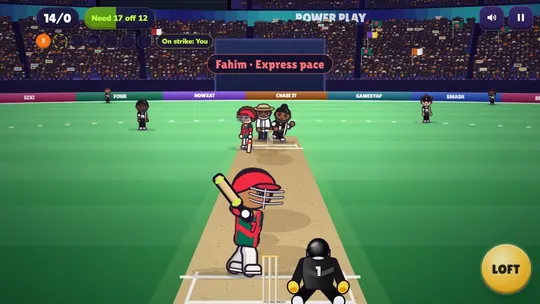
A worked chase: 17 runs off 12 balls
Say you need 17 from the last two overs, with all your wickets in hand. That is a little under 1.5 runs a ball — tough, but very possible without slogging.
- First over: aim for about eight. One four plus a few singles and a two gets you there. Lofting only the one ball you read early keeps the risk low.
- Check the equation again. If you now need nine from six, one boundary and a few singles finish the job; you still don't need a six.
- Final over: go big only if you must. Needing 12 or more from the last few balls is when the lofted shot becomes the right choice.
Facing spin and swing
- Swing bowling moves sideways in the air; wait a fraction longer before committing.
- Off-spin and leg-spin turn after bouncing; play with the turn rather than across it.
- Bouncers and yorkers are the fast bowler's weapons: duck or pull the bouncer, dig out the yorker with a straight, defensive block.
Common batting mistakes
| Mistake | What usually happens | Fix |
|---|---|---|
| Swinging at every ball | Missed straight balls and bowled dismissals | Wait for a ball you have read |
| Lofting too early in the chase | Caught in the deep with plenty of time left | Build with ground shots first |
| Ignoring the scoreboard | Taking risks you don't need | Recheck runs and balls after each over |
| Same timing for pace and spin | Too early against slow balls | Wait longer for spin, be ready sooner for pace |
Play cricket in your browser
Willow Smash is our free cricket batting game in a packed, floodlit stadium. Chase targets through twelve stages and endless stages beyond, face pace, swing, bouncers, yorkers and spin, play the daily challenge and daily match, or send a friend a match link where you both face the very same balls.
Here is how these cricket batting tips apply to its real controls:
- Time the ring. Tap the field or press Space as the ring around the ball closes for a shot along the ground. Early pulls to the leg side, on time goes straight and late cuts to the off side.
- Loft with care. Tap LOFT, or press Up or W, to go for six. Fielders can catch a mistimed lofted shot, and missing a straight ball can get you bowled.
- Running is built in. Your batters run their singles, twos and threes, and an odd number of runs swaps the strike.
- Stars reward clean chases. In each stage you earn stars for winning, for losing no wicket and for finishing with two or more balls to spare.
- Practise pressure. The Super Over mode is a quick six-ball chase with two wickets, ideal for practising the final-over decisions above.

For other ball-timing games, see our penalty kick tips or browse free sports games online.
FAQ
How do you time a shot in a cricket game?
Watch where the ball will bounce and swing as it reaches you. In Willow Smash you tap as the ring around the ball closes; tapping a little early plays towards the leg side and a little late towards the off side.
When should you hit a six?
Go for a lofted shot when you have read a full ball early, when you need quick runs at the end of a chase, or when there is no fielder in that direction. Otherwise keep the ball on the ground to avoid being caught.
What is the required run rate in cricket?
The required run rate is the number of runs still needed divided by the overs remaining. It tells you how many runs per over you must score to win the chase. For example, 30 runs needed from 5 overs is a rate of 6. In short chases, dividing runs by balls left is often easier to track.
Can I play a cricket game online without downloading?
Yes. Willow Smash runs free in the browser on phones, tablets and computers, so you can bat straight away with no download or install. Guests can play a few games each day, and signing in to a free GamesYap account removes that limit.
What does rotating the strike mean?
Rotating the strike means taking singles (or threes) so the two batters keep swapping ends and the scoreboard keeps moving. It stops the bowler settling into a rhythm against one batter and avoids dot balls, which build pressure in a chase. In Willow Smash, an odd number of runs swaps the strike automatically.
