Guides
The Racing Line Explained: How to Take Corners Faster in Racing Games
The racing line explained simply: turn-in, apex and exit, braking before corners, slow in fast out, chicanes and slipstreaming, with tips for racing games.
By GamesYap Team5 min read
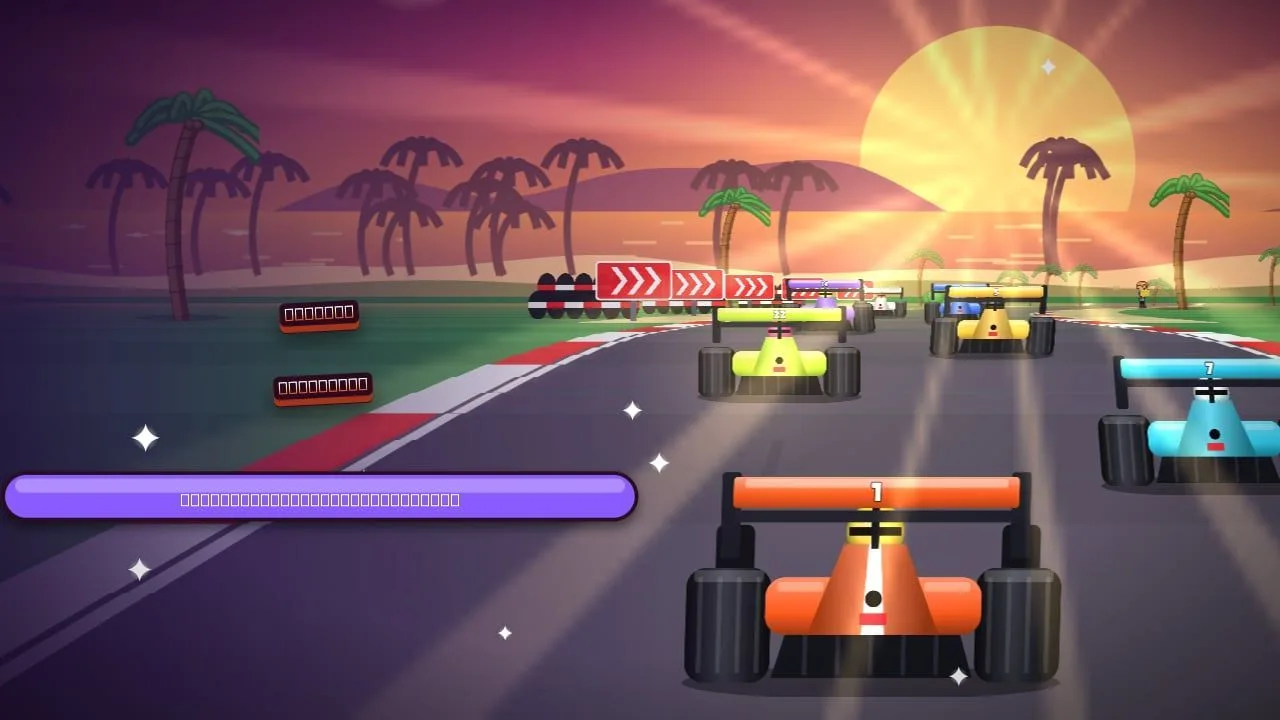
Ask any racing driver how to go faster and the answer is rarely "more speed on the straights". Races are won in the corners, and the secret is the racing line: the path around a track that lets you carry the most speed through each turn. Once you understand it, you will gain time in every racing game you play — from grand-prix circuits like Chicane Champions to kart racers like Zoomy Karts.
This guide explains the racing line in plain language, with no engineering degree required.
What is the racing line?
The racing line is the fastest route through a corner. Instead of following the middle of the road, it uses the full width of the track to make the corner as wide and gentle as possible. A wider curve can be taken at a higher speed, which means you lose less time and leave the corner faster.
Every corner on the racing line has three key points:
- Turn-in point — where you start steering into the corner, usually from the outside edge of the track.
- Apex — the point where your car comes closest to the inside of the corner.
- Exit point — where you finish the corner, back out at the outside edge, already accelerating.
This shape is often called outside – inside – outside.
Slow in, fast out
The most important rule of cornering is slow in, fast out. Beginners often arrive at a corner too fast, brake while turning, slide wide and crawl out of the exit. Experienced drivers do the opposite:
- Brake in a straight line before the corner, while the car is stable.
- Turn in once your speed is right for the corner.
- Pick up speed from the apex onward, unwinding the steering as you go.
Why does the exit matter so much? Because your exit speed carries all the way down the next straight. A small gain at the exit becomes a big gain by the end of the straight.
Early apex vs late apex
Where exactly should the apex be? It depends on what comes next.
| Apex type | How it feels | When to use it |
|---|---|---|
| Early apex | Turn in early, touch the inside early | Rarely — it often pushes you wide at the exit |
| Geometric apex | The apex in the middle of the corner | Single corners with a short straight after |
| Late apex | Turn in later, apex after the middle | Corners before a long straight — the most common choice |
A late apex lets you straighten the car sooner and accelerate earlier, which is why it is the go-to choice for most corners in racing games too.
Chicanes and linked corners
A chicane is a quick left-right (or right-left) pair of corners. You cannot take the perfect line through both, so you sacrifice the first corner to set up the second: stay a little tighter on the first, so you are in the right place for a strong exit from the second.
The same idea applies to any series of linked corners. Think about the corner that leads onto the longest straight, and plan your line backwards from there.
Overtaking with the slipstream
Drafting, or slipstreaming, is the other big racing skill. A car pushing through the air leaves a pocket of lower air resistance behind it. Tuck in behind a rival on a straight and you gain speed; then pull out just before the braking zone to pass.
In Chicane Champions, slipstreaming behind a rival is built into the game, so following closely on a straight is the best way to set up an overtake into the next corner.
Applying the racing line in racing games
Racing games simplify the physics, but the line still matters:
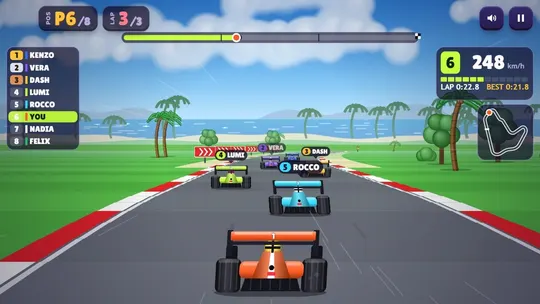
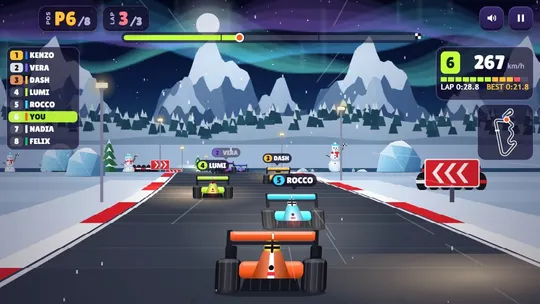
- Grand-prix games: In Chicane Champions, brake before the corner, use the whole width of the track and stay on the tarmac. Live standings and lap times show instantly whether a new line is faster.
- Kart racers: In Zoomy Karts, the drift changes things a little. Start your power-slide early on the outside of a hairpin, hold it through the apex to charge a mini-turbo, and release it as you point down the exit. Our kart racing tips go deeper.
- Traffic racers: On a highway in Turnpike Rush the "corner" is the gap between cars. Look far ahead and pick your lane early instead of swerving at the last moment.
A five-step practice plan
- Pick one track and race it several times in a row.
- Focus on one corner that feels slow. Try braking a little earlier and turning in a little later.
- Watch your exit. Are you on the throttle earlier than before? Is your speed higher on the following straight?
- Compare lap times. Small, steady improvements add up.
- Move on to the next corner only when the first one feels natural.
When you are ready to try your skills on different tracks, our list of the best free racing games has plenty of options, and the racing games category has them all.
FAQ
What is the racing line in simple terms?
The racing line is the fastest path through a corner. It uses the full width of the track — starting on the outside, touching the inside at the apex and finishing on the outside — so the corner becomes a wider, gentler curve that you can take at a higher speed.
What does "slow in, fast out" mean?
It means you should slow down enough before a corner so that you can accelerate early on the way out. Braking in a straight line, turning in smoothly and accelerating from the apex gives you a higher speed on the following straight, which saves more time than braking late.
What is the apex of a corner?
The apex is the point where your car is closest to the inside edge of a corner. On most corners a late apex — slightly after the middle of the turn — is fastest, because it lets you straighten the car and accelerate earlier.
Does the racing line matter in racing games?
Yes. Even arcade racing games reward a smooth, wide line through corners. Using the full track, braking before the turn and accelerating out of it will usually lower your lap times, and in kart games it also helps you hold longer drifts for bigger boosts.
What is slipstreaming in racing?
Slipstreaming, or drafting, means driving close behind another car on a straight. The leading car takes most of the air resistance, so the following car gains speed. Drivers use that extra speed to pull out and overtake before the next corner.