Tips
Snake Game Tips: How to Grow Longer, Manage Space and Beat Your High Score
Snake game tips for a higher score: manage open space, use wall-hugging and zigzag patterns, plan safe routes to food and keep calm as the snake speeds up.
By GamesYap Team6 min read

The classic snake game is easy to learn and surprisingly hard to master: every fruit you eat makes the next one harder to reach safely. These snake game tips focus on the real skill behind a big score, which is managing space, not chasing food. We will use Garden Snake, our cheerful garden version of the classic, to show each idea in action.
Why snakes crash
Almost every game over has one of three causes:
- Trapping yourself. The head turns into a pocket enclosed by its own tail, and there is no way out.
- Late turns. You see the wall or tail but react a moment too late, often when the snake has sped up.
- Greedy routes. You take the shortest path to the food, cutting the board in half, and the tail closes the gap behind you.
Only the second one is about reflexes. The other two are planning mistakes, which is good news: planning can be learned, and most of the snake game tips below are about exactly that.
Think in space, not in food
A beginner looks at the fruit. An experienced player looks at the empty space around the snake.
- Keep the board in one piece. Before every turn, ask whether your path splits the open area into two parts. If it does, the part you end up in must be big enough for your whole body.
- Prefer big open areas. When you have a choice, turn towards the larger empty region.
- Remember the tail moves. The cell where your tail is now will be free in a moment. Following your own tail is one of the safest moves in the game, because that space keeps opening up in front of you.
- Food can wait. If the fruit sits in a tight corner, take a longer, safer loop to reach it.
Movement patterns that keep you alive
Once your snake is long, freestyle steering gets dangerous. Patterns make the snake predictable, and predictable is safe.
Wall-hugging
Run along the edges of the board in a big loop. This keeps the centre open and your body neatly stacked against the border. It is the easiest pattern for medium-length snakes.
Zigzag lanes
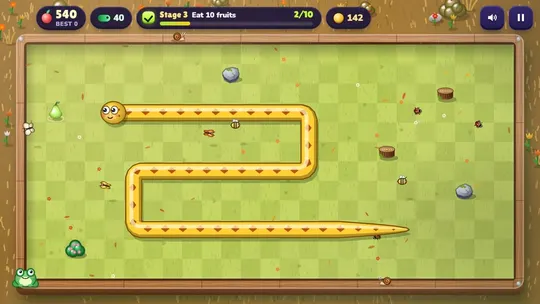
For long snakes, sweep the board in parallel lanes: go across, turn down one row, come back, turn down again. Your body fills the board in neat rows like a lawnmower, and there is always a clear lane next to you. When food appears, break the pattern briefly, eat it, then return to the lanes.
Avoid the U-turn trap
Turning back on yourself in a narrow space, two quick turns the same way, is the classic way to bite your own tail. Leave at least one empty row between your body and the path you are turning into.
Handling speed
Many snake games speed up as you grow, which turns safe plans into close calls.
- Turn early, not late. At high speed, start each turn one cell sooner than feels necessary.
- Use the input buffer. Many games remember a quick double turn pressed in a row. Practise tapping two turns in rhythm for tight U-shapes, rather than waiting for the first turn to finish.
- Keep your eyes ahead of the head. Look two or three cells in front of the snake, not at the head itself.
- Prefer long straight lines. Fewer turns means fewer chances to mistime one.
Bonus food and obstacles
| Item | Typical behaviour | Should you chase it? |
|---|---|---|
| Regular fruit | Always present, small growth | Yes, by the safest route |
| Bonus fruit | Big score, disappears on a timer | Only if the path is clear |
| Fixed obstacles | Block cells permanently | Treat them like walls when planning |
Bonus items are designed to tempt you into risky routes. The best players skip a bonus when the only way to reach it is through a narrow gap.
Applying these snake game tips in Garden Snake
Garden Snake keeps the classic rules and adds a few friendly twists. Here is how the advice above fits its real mechanics.
- Controls. Swipe anywhere, tap the on-screen arrow pad, use the arrow keys or WASD, or click beside the snake's head. The snake waits for your first move, so take a second to look at the board before you start. Quick double turns are remembered, which helps with tight U-turns.
- Speed. The snake gets a little faster with every fruit it eats, up to a top speed, so early turns matter more as the run goes on.
- Solid walls and obstacles. The wooden planter walls, rocks, bushes, stumps, mushrooms and your own tail all end the run. There is no wrap-around, so wall-hugging needs a one-cell gap at the corners.
- A forgiving turn. If you turn just too late, the snake holds for one beat so you can still escape. Don't rely on it, but it saves many runs.
- Garden goals. Each garden shows a goal at the top: eat 6 fruits in the first, then 8, 10 and 12. Clearing a goal opens the next garden, from the Spring Lawn to the Summer Meadow, the Autumn Orchard, the Moonlit Garden and the snowy Winter Garden, and later gardens repeat with more obstacles.
- Combos. Reach each fruit quickly to chain quick-bite combos, so a short, safe route pays twice.
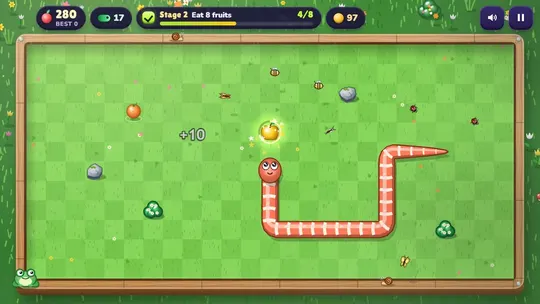
- Golden apple. It is worth +50 and grows the snake by two, but it has a ring timer. Grab it only when the path is clear.
When the run ends, you can play again, take a free continue (it has a short timer and a daily limit) or head to the menu. After a continue, the snake can pass through obstacles for three seconds, so use that moment to steer into open space.
If you like steering under pressure, the lane-switching runs in Dash Alley and our endless runner tips use the same "look ahead" habit. For calmer grid thinking, try the 8x8 block puzzle strategy, or explore more arcade games.
FAQ
What is the best strategy for the snake game?
The best strategy is to manage space instead of chasing food. Keep the open area of the board in one piece, follow your own tail when you can, and use steady patterns such as wall-hugging or zigzag lanes once the snake is long. Take the safest route to each fruit rather than the shortest, and skip risky bonus items.
How do you get a high score in the snake game?
A high score comes from long, safe runs. Eat steadily, avoid trapping yourself, and turn early as the snake speeds up. In games with combos, short safe routes to each fruit add extra score. Bonus fruit is worth chasing only when the path is clear, because one crash ends the whole run.
How do you stop running into your own tail?
Plan turns so you never enter a pocket smaller than your body. Leave an empty row between your body and the path you are turning into, avoid quick U-turns in tight spaces, and look two or three cells ahead of the head. Following your tail is safe, because the space it leaves keeps opening up.
Does the snake get faster as it grows?
In many snake games, yes. In Garden Snake the snake speeds up a little with every fruit it eats until it reaches a top speed. Because of this, start your turns slightly earlier as the run goes on, and prefer long straight lines with fewer turns.
Is Garden Snake good for kids?
Yes. Garden Snake has a smiling cartoon snake, bright gardens with friendly bugs and simple swipe or arrow controls. The snake waits for the first move, and it holds for one beat if a turn comes just too late, which helps younger players learn without frustration. It runs in the browser on phones, tablets and computers.