

Guides
Word Puzzle Tips: Win the Daily Five-Letter Word and Find Every Hidden Word
Word puzzle tips: smart first guesses for a daily five-letter word, how to use the letter colours, and fast strategies for word search grids.
By GamesYap Team6 min read
Word puzzles are the perfect five-minute break: they warm up your brain, grow your vocabulary and give you a small win every day. This guide covers two well-loved kinds — the daily five-letter word and the word search — with tips you can use straight away.
The daily five-letter word
You have six guesses to find a secret five-letter word. After each guess, every letter is coloured: one colour for a right letter in the right spot, another for a right letter in the wrong spot, and grey for a letter that is not in the word.
Pick a strong first word
A good opener uses five different common letters, including two or three vowels. Words built from letters like E, A, R, T, O, S, L, N reveal the most in one go. Avoid repeated letters in your first guess — they waste information.
Use your second guess to explore
If the first guess shows only one or two hits, try a second word with five completely new common letters. Two exploring guesses usually cover ten letters and make the answer much easier to find.
Play the colours, not just the letters
- A letter in the right spot stays there in every later guess.
- A letter in the wrong spot must move — and it cannot go back to any spot where it was already marked.
- Grey letters are gone: don't use them again.
Think about common endings
Many five-letter words end in -ER, -ED, -LY, -EST or a final E or Y. When you know two or three letters, try the common patterns first.
Remember double letters
If you are stuck with few options left, the answer may repeat a letter (like EERIE or APPLE).
In many daily word games, including ours, a doubled letter in your guess is only coloured as often as it appears in the answer. If you guess a word with two Es and only one turns coloured, the answer has just one E.
A worked example
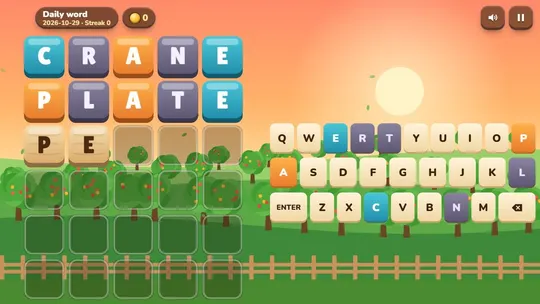
Here is a real game in progress. The first guess, CRANE, shows A in the right spot, C and E in the word but in the wrong spots, and R and N grey. The second guess, PLATE, confirms A, adds P in the right spot, and turns L and T grey. E is blue again in the last spot.
Now put the clues together:
- The word fits the pattern P _ A _ _.
- It contains C (not first) and E (not last).
- It has no R, N, L or T.
The only open spots are 2, 4 and 5, and E cannot be last, so E goes in spot 2 or 4. Try E second: P E A _ _, with C in spot 4 or 5. PEACH fits every clue — found by elimination, not by guessing.
Word search
In a word search, the listed words are hidden in a grid of letters — across, down, diagonally and sometimes backwards.
- Hunt for the rare letters first. Words containing Q, Z, X, J or K are easiest to find because those letters stand out.
- Scan for the first two letters together, not just the first letter. Spotting "TH" or "QU" is faster than checking every T.
- Work row by row. A slow, steady scan beats random searching.
- Check backwards words when only a few remain — they are the ones people miss.
- Look for double letters. A pair like "LL" or "EE" is easier to spot in a grid than a single letter.
Search one word at a time
Trying to hold the whole list in your head slows you down. Pick one word, find its rarest letter, and check all eight directions around every copy of that letter in the grid. When the second letter appears next to it, follow the line to the end. Then move to the next word.
The word wheel
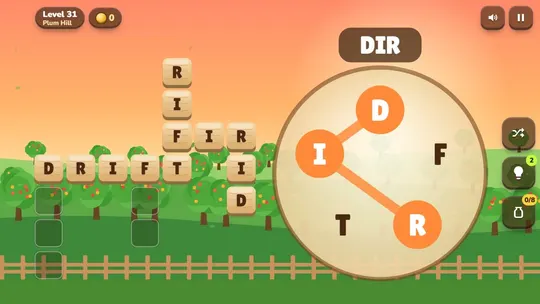
A word wheel gives you a ring of letters and a small crossword to fill. Every word you make must use letters from the wheel, each only once per word.
- Start short. Three- and four-letter words fill in fast and show you letters for the longer words.
- Use endings. Adding -ED, -ER or -S turns one word into several.
- Shuffle when you stall. Seeing the letters in a new order often reveals a word you missed.
- Find the longest word last. The crossword letters you have already filled usually give it away.
Three word games in one
Word Orchard is our free word game with three ways to play: the Daily Word (guess the five-letter word in six tries, the same word for everyone each day), the Word Wheel (swipe across letters to fill a little crossword) and Word Search with 40 themed grids. It runs in the browser on any phone, tablet or computer.
Some details that help with the daily word puzzle tips above:
- Colours. In the Daily Word, orange means the right letter in the right spot, blue means the letter is in the word somewhere else, and grey means it is not in the word. The on-screen keyboard keeps the best colour for each letter.
- One word, one streak. The Daily Word is the same for everyone each day, and solving it keeps your daily streak growing.
- Word Wheel. 120 levels in ten orchards, with shuffle and hints. Other real words you find go in the bonus jar, and every 8 give coins.
- Word Search. 40 themed grids that grow from 7×7 to 12×12. Early grids hide words only across and down; later ones use all eight directions. Two hints a level circle the first letter of a word.
- Stars reward quick, clean solves, so try a level without hints first.
More quick ideas for a short break are in our list of quick games for short breaks.
FAQ
What is a good first word for a five-letter word puzzle?
Choose a word with five different common letters and two or three vowels, such as words built from E, A, R, T, O, S and L. These letters appear in many answers, so the first guess tells you the most. Avoid repeating a letter in your opener, and use your second guess to test five new letters if the first one shows few hits.
What do the colours mean in a daily word game?
Usually one colour marks a correct letter in the correct position, another marks a correct letter in the wrong position, and grey means the letter is not in the word at all. In Word Orchard, orange marks the right spot and blue the wrong spot. A doubled letter is only coloured as often as it appears in the answer.
How do you find words faster in a word search?
Look for words with rare letters like Q, Z, X or J first, scan for two-letter combinations instead of single letters, and remember that some words run diagonally or backwards. Searching for one word at a time, starting from its rarest letter, is usually faster than scanning for the whole list.
Is there a free daily word puzzle without download?
Yes. Word Orchard on GamesYap has a free Daily Word that is the same for everyone each day, and it plays in the browser with no download. After the daily puzzle, you can keep playing the Word Wheel and Word Search as long as you like, on a phone, tablet or computer.
