

Guides
Klondike Solitaire Strategy: 9 Tips to Win More Games
Klondike solitaire rules plus nine strategy tips: which cards to move first, when to use the foundations, draw 1 vs draw 3 and avoiding dead ends.
By GamesYap Team6 min read
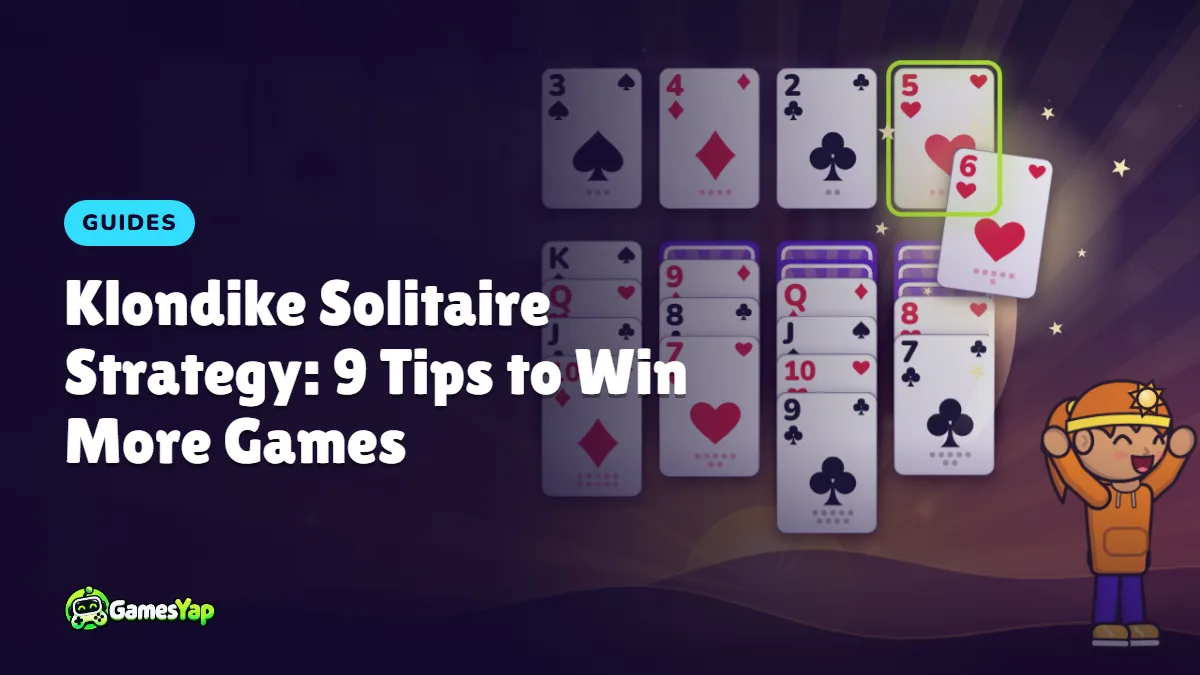
Klondike is the solitaire most people simply call "solitaire": seven columns, a stock pile and four foundations to build from Ace to King. Many games feel like pure luck, but good players win noticeably more often than beginners — because the order in which you make moves matters.
The rules in one minute
- Twenty-eight cards are dealt into seven columns; only the top card of each column is face up.
- In the columns you build down in alternating colours (a red 7 on a black 8).
- Only a King (or a sequence starting with a King) can go into an empty column.
- The foundations are built up by suit, from Ace to King.
- The remaining cards form the stock. In Draw 1 you turn one card at a time; in Draw 3 you turn three and can play only the top one.
You win when all 52 cards are on the foundations.
9 tips to win more often
- Reveal face-down cards first. Every hidden card is a mystery that may block you. Prefer moves that turn over a face-down card.
- Work on the biggest columns. The longest columns hide the most cards. Freeing them early gives you more options later.
- Don't empty a column without a King to put in it. An empty column is only useful if a King (or King-led run) is ready to move there.
- Play Aces and Twos to the foundations right away. They never help you in the columns.
- Be careful with higher cards on the foundations. Moving a 6 to the foundation might leave you with nowhere to place a red 5 later. Keep mid cards in the columns until both colours below them are safe.
- Choose which King fills an empty column. If you have a choice, pick the King whose colour matches the Queen you can play next.
- Use the stock thoughtfully. Before drawing, make all the useful column moves you can — a drawn card may need a home you just created.
- In Draw 3, remember the order. Cards come back in the same groups of three, so playing one card from the waste changes which cards you see on the next pass. Sometimes skipping a playable card unlocks a better one.
- Undo is a learning tool. If your game allows undo, use it to test which column to open first; you will start seeing patterns quickly.
A worked opening
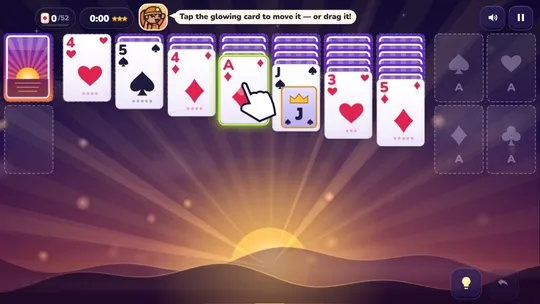
Let's apply the tips to a real deal. In the opening below, the seven face-up cards are 4♥, 5♠, 4♦, A♦, J♠, 3♥ and 5♦.
- A♦ goes straight to the foundation (tip 4). It also uncovers a face-down card in the fourth column.
- Now a red 4 can go on the 5♠ — but which one? The 4♥ sits alone in the first column, so moving it would empty that column with no King ready to fill it (tip 3). The 4♦ sits on top of hidden cards, so moving it reveals one (tip 1). Move the 4♦.
- Look at what the new cards allow before you touch the stock (tip 7). Maybe a black 4 has appeared for the 3♥, or a 2♦ for the foundation.
Two small choices, and you have already turned over two hidden cards without giving anything away. That is what good Klondike solitaire strategy looks like move by move.
Common mistakes
| Mistake | Why it hurts | Better habit |
|---|---|---|
| Playing every card from the waste first | Hidden cards stay hidden | Prefer moves that reveal a face-down card |
| Emptying a column too early | The space sits unused | Wait until a King is ready |
| Rushing cards to the foundations | You lose places to park lower cards | Keep mid cards in the columns for now |
| Drawing before checking the columns | You miss moves that change what you need | Finish column moves, then draw |
| Moving a whole run when part will do | You uncover nothing new | Move only the cards that open something |
Draw 1 or Draw 3?
Draw 1 is more relaxed and wins far more often — perfect for learning. Draw 3 is the classic challenge: fewer games can be won and planning ahead matters much more.
A good path is to learn on Draw 1 until revealing hidden cards and saving empty columns feel automatic, then switch to Draw 3. The habits are the same; Draw 3 simply punishes careless draws more.
Play Klondike for free
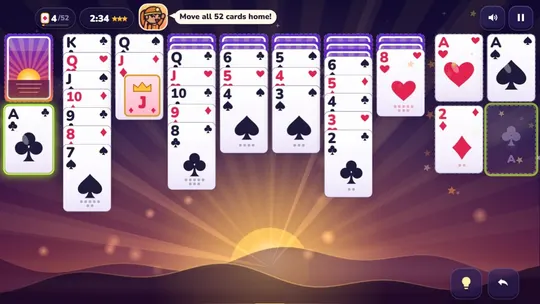
Solitaire Sunrise is our free Klondike solitaire with Draw 1 and Draw 3, tap-to-move or drag, and unlimited undo. Relaxed deals can always be won (your very first deal is a gentle one), while Random deals are true shuffles. Here is how the strategy maps onto its features:
- Tap or drag. Tap a card to send it to a good spot, or drag it yourself. Dragging is better when you want to choose between two possible moves, like the two red 4s above.
- Free undo and hints. Undo and the light-bulb hint are always free, so you can test which column to open first.
- Stars for speed. Win in under 4 minutes for three stars. Speed comes from good habits, not rushing: fewer wasted moves mean a faster game.
- The Sunrise Trail. Twenty-four hand-picked deals in four legs, from gentle Draw 1 deals to tricky Draw 3 ones, each sure to be winnable.
- The daily deal is the same for everyone, which makes it a fair test of your planning.
If you enjoy it, try Spider Solitaire Sunrise next, with help from our spider solitaire guide.
FAQ
Can every game of Klondike solitaire be won?
No. Some Klondike deals cannot be won no matter how you play, especially in Draw 3. Games with "winnable" or relaxed deals, like Solitaire Sunrise, only give you deals that have a solution. In Solitaire Sunrise, the Sunrise Trail and Relaxed deals are always winnable, while Random deals are true shuffles for players who want the classic challenge.
Should I move cards to the foundation right away?
Aces and Twos, yes. Higher cards are better kept in the columns until you are sure you will not need them to hold a lower card of the opposite colour. A useful check: a card is usually safe to move up when both lower cards of the opposite colour are already on the foundations.
What is the difference between Draw 1 and Draw 3?
In Draw 1 you turn over one stock card at a time and can play every card. In Draw 3 you turn three at once and only the top one is playable, which makes the game harder and planning more important.
What goes into an empty column in solitaire?
In Klondike only a King, or a sequence that starts with a King, can be moved into an empty column. That is why you should not empty a column until a King is ready to move there. If you have a choice of Kings, pick the one that lets you continue building with cards you can already see.
