

Guides
Spider Solitaire Guide: 1, 2 and 4 Suits Explained, Plus Winning Tips
Learn spider solitaire: the deal, building runs from King to Ace, 1-suit vs 2-suit vs 4-suit play, dealing from the stock and strategies to win more often.
By GamesYap Team6 min read
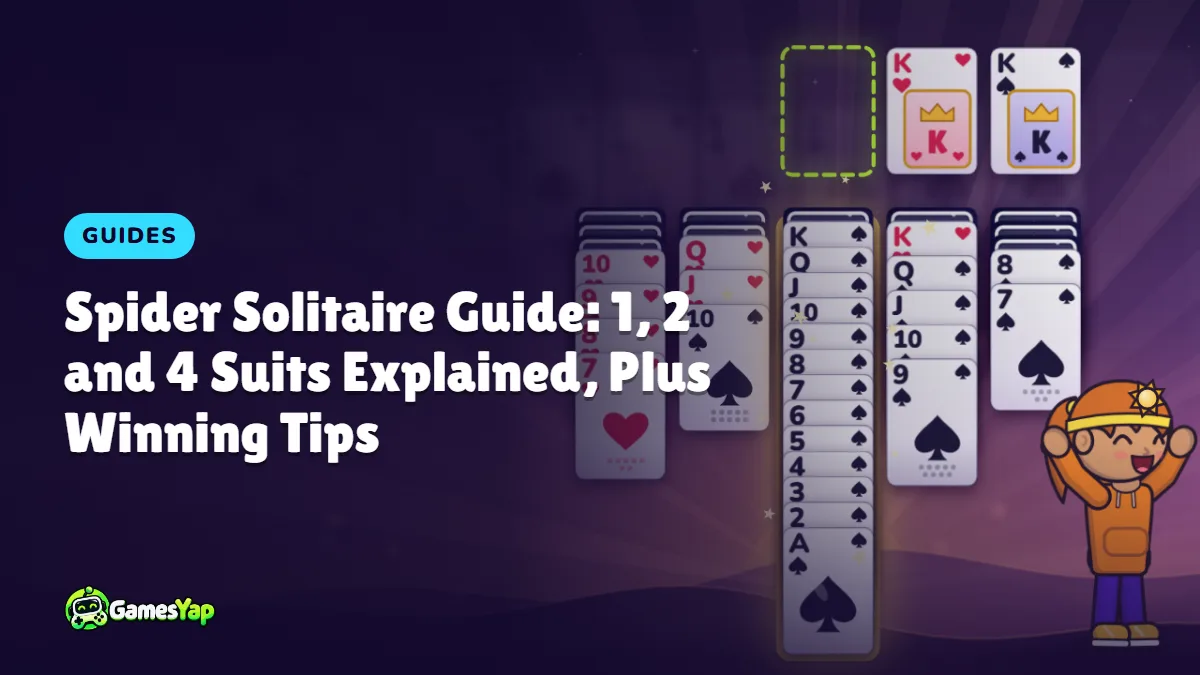
Spider solitaire uses two decks and ten columns, and its goal is satisfying: build complete runs from King down to Ace in one suit, and each finished run flies off the table. Clear all eight runs and you win. It is more strategic than Klondike, and choosing the number of suits lets you set the difficulty.
The setup
- 104 cards (two decks) are used.
- 54 cards are dealt into ten columns — the first four columns get six cards, the other six get five. Only the top card of each column is face up.
- The other 50 cards form the stock, dealt ten at a time (one onto every column). That gives you exactly five deals per game.
How to move cards
- You may place a card on any card one rank higher, regardless of suit (a 6 on any 7).
- You may move a group of cards together only if they form a run in the same suit in descending order.
- Any card or same-suit run can move into an empty column.
- When a full run from King to Ace of one suit is complete, it is removed to the foundation.
1 suit, 2 suits or 4 suits
- 1 suit (spades only): every run is same-suit, so it is the friendliest version and great for learning.
- 2 suits: mixed runs appear and you must untangle them. The real challenge starts here.
- 4 suits: very hard; experienced players win only some deals.
The card count is always 104; only the mix changes:
| Mode | Suits used | Cards of each suit | Runs to build per suit |
|---|---|---|---|
| 1 suit | Spades | 104 | 8 |
| 2 suits | Spades and hearts | 52 | 4 |
| 4 suits | All four | 26 | 2 |
With more suits, two cards of the same rank are less likely to match in suit, so more of your stacks end up mixed.
Strategies that work
- Build in suit whenever you can. Mixed-suit stacks cannot be moved as a group, so they block you later.
- Empty a column as early as possible. An empty column is the most powerful tool in Spider — use it to reorder runs, not as a parking spot.
- Expose face-down cards. Prefer moves that reveal a hidden card, just like in Klondike.
- Move higher cards into place before dealing. Every new deal drops a card on each column, including your neat runs. Tidy up first.
- Don't deal while you have an empty column. In most rules you cannot deal from the stock while a column is empty — and if you can, it wastes your best resource.
- Undo to explore. If undo is allowed, try both options of a hard choice and keep the one that frees more cards.
A worked opening
Take the 1-suit deal in the screenshot below. The ten face-up cards are 10, 5, Q, Q, 3, J, 8, 2, 2 and 5, all spades.
- Move the 10 onto the J. It reveals a hidden card in the first column, one of the four columns that started with more cards.
- Move a 2 onto the 3. Both 2s qualify; pick either, since both columns hide the same number of cards. Now check what the new cards allow.
- Keep going before you deal. Each revealed card may open another move. Only when nothing useful is left should you tap the stock.

Fixing a mixed run
In 2-suit and 4-suit games, mixed stacks are unavoidable. The trick is to repair them before they bury important cards. Say a column holds a heart run from King to 7, then a 6♠, then hearts from 5 down to 2. The 5♥ to 2♥ can move together, because they share a suit, but the 6♠ cannot move with them. To fix it, move the 5♥–2♥ group onto another 6♥ or into an empty column, move the 6♠ away, and then bring a 6♥ and the hearts back onto the 7♥. An empty column makes this far easier, which is why it is your most valuable resource.

Common mistakes
- Building off-suit just because you can. It is legal, but every mixed join is a stack you will have to untangle later.
- Filling an empty column with a single low card. Use it to reorder runs, then free it again.
- Dealing too early. Each deal adds a card to all ten columns, so make every useful move first.
- Ignoring the tallest columns. They hide the most face-down cards, and those cards are often the ones you need.
Play spider solitaire for free
Spider Solitaire Sunrise lets you play with 1, 2 or 4 suits in the browser. Relaxed 1-suit and 2-suit deals are proven winnable by our solver, and your very first deal is a gentle one, so it is a calm place to learn.
A few features make these spider solitaire tips easy to practise. Tap a card to move its run automatically, or drag it. Tap the deck or press Space to deal ten new cards, and every column must hold a card first. Undo (U) and hints (H) are always free, and the smart hints never send you in circles. For a longer challenge, the Silk Trail offers 24 hand-picked deals in four legs, from gentle one-suit paths to tricky two-suit webs, and a daily deal is the same for everyone. Prefer the classic seven columns? Try Solitaire Sunrise with our Klondike solitaire strategy guide.
FAQ
How many cards are in spider solitaire?
Spider solitaire uses 104 cards — two full decks. Fifty-four are dealt into ten columns at the start and fifty stay in the stock, which you deal ten at a time. That gives five deals in total, so each one is worth planning: make every useful move before you deal again.
Which is easier, 1-suit or 4-suit spider solitaire?
One suit is by far the easiest because every run you build is already in suit. Two suits is a good middle step, and four suits is a hard challenge that even experienced players do not always win. Start with one suit, then move up once you win comfortably.
Can you put any card in an empty column in spider solitaire?
Yes. Unlike Klondike, Spider lets you move any card or any same-suit run into an empty column, which is why empty columns are so valuable. Use an empty column to break up a mixed stack or reorder a run, then free it again rather than leaving a single low card there.
When should you deal new cards in spider solitaire?
Deal only after you have made every useful move, especially those that turn over face-down cards or complete runs. Each deal covers every column, so tidying first keeps your runs moveable. Most rules, including Spider Solitaire Sunrise, also need every column to hold a card before you can deal.
