Guides
Minesweeper Strategy: The Number Patterns Every Player Should Know
Minesweeper strategy: how to read the numbers, where to start, flagging and chording, and the 1-1, 1-2 and 1-2-1 patterns that solve most boards.
By GamesYap Team6 min read
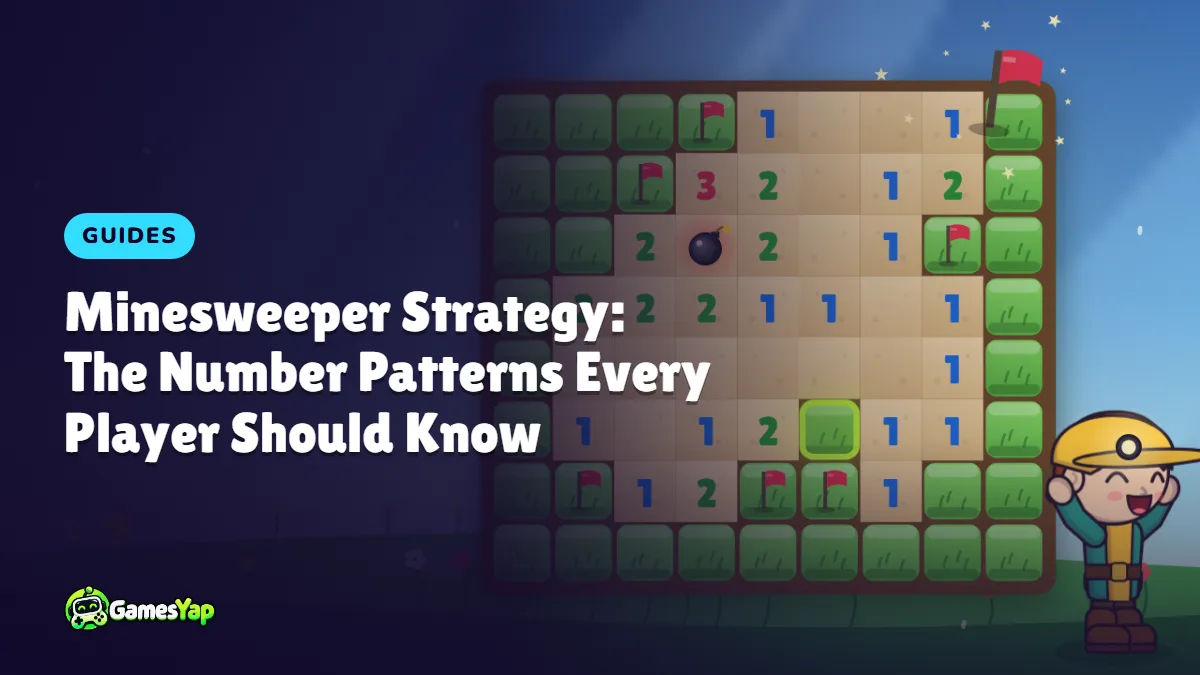
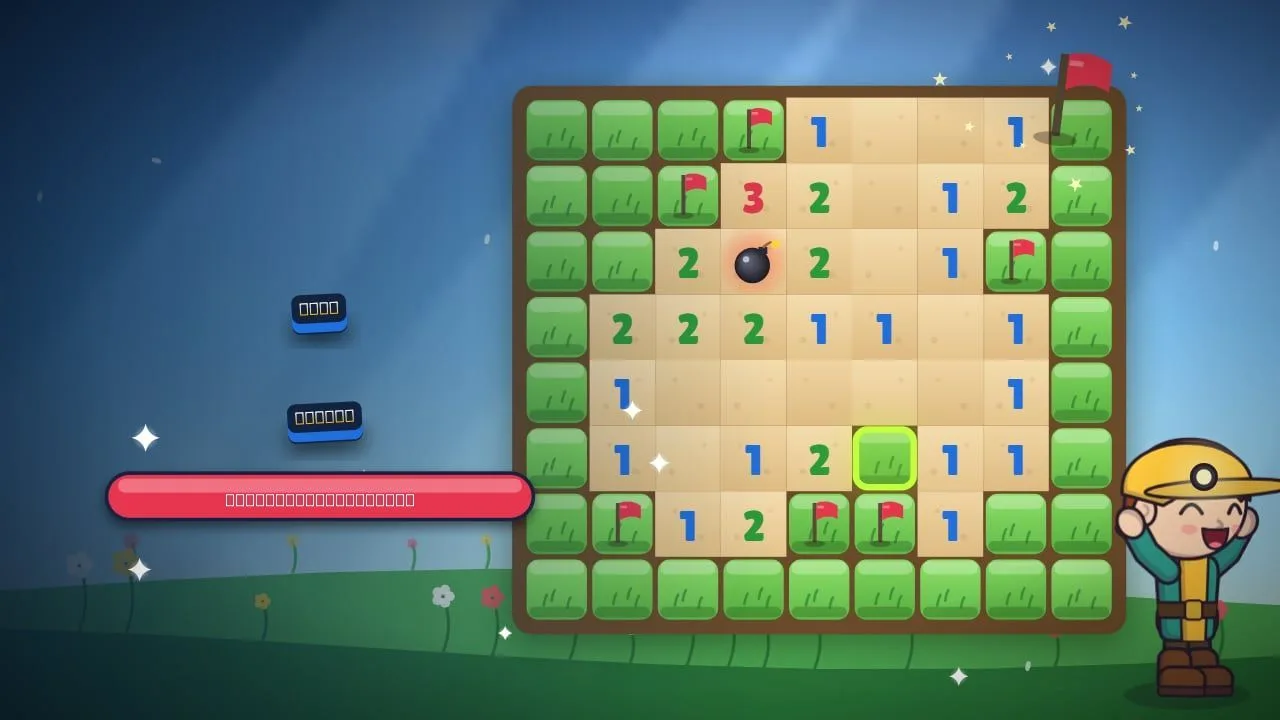
Minesweeper is a pure logic puzzle hiding behind a simple grid. Every number tells you how many mines touch that cell — including diagonals — and with a handful of patterns you can clear almost every board without a single guess. Here is how experienced players think.
Reading the numbers
Each revealed number counts the mines in the up to eight cells around it. A 1 means exactly one of its neighbours is a mine; a 3 means three are. Empty cells (zero) have no mines around them, which is why clicking one opens a whole area at once.
Where to start
Your first click is always safe in modern versions. Start near the middle: it is more likely to open a large empty area than a corner. Once you have an opening, work from its edges inward.
Flagging and chording
- Flag a cell when you are certain it is a mine. Flags are reminders for you, and they make the next trick possible.
- Chording: when a number already has as many flags around it as its value, tapping that number reveals all its other neighbours at once. It is much faster than digging cell by cell — but only works if your flags are correct.
The two basic rules
- If a number has exactly as many hidden neighbours as its value, all of them are mines. A 1 with only one hidden cell next to it means that cell is a mine.
- If a number already has all its mines flagged, every other hidden neighbour is safe.
These two rules alone solve most of an easy board.
Patterns that solve the rest
- 1-1 on a wall: two 1s side by side along a straight edge of revealed cells. The mine for the first 1 is shared with the second, so the cell beyond the second 1 (on the open side) is safe.
- 1-2 on a wall: a 1 next to a 2. The 2 needs one more mine than the 1 can give it, so the hidden cell next to the 2 that the 1 cannot see must be a mine.
- 1-2-1: a classic. The two cells under the 1s are mines, and the cell under the 2 is safe.
- 1-2-2-1: the two cells under the 2s are mines; the cells under the 1s are safe.
Learning to spot these patterns is what makes experts fast.
A worked example: proving the 1-2-1
Patterns are easier to trust once you have proved one yourself. Imagine a straight edge of revealed cells reading 1, 2, 1, with three hidden cells A, B and C directly beyond them:
| A | B | C |
|---|---|---|
| 1 | 2 | 1 |
- The 2 touches A, B and C, so two of those three are mines.
- The left 1 touches A and B, so at most one of them is a mine.
- The right 1 touches B and C, so at most one of them is a mine.
If B were a mine, the 2 would need its second mine in A or C — but either choice would give one of the 1s two mines. So B is safe, and the 2's two mines must be A and C. No guessing, just counting. Every pattern in the list above can be proved the same way, and once you have done it a few times, you start to see them at a glance.
Common mistakes
- Flagging on a hunch. A wrong flag makes chording dig a mine. Only flag when a rule or pattern proves it.
- Looking at one number at a time. Most deductions come from two neighbouring numbers that share hidden cells, so compare them.
- Forgetting the diagonals. A number counts all eight neighbours, including the corners.
- Racing the clock too early. Speed comes from recognising patterns, not from tapping faster. Learn to be accurate first.
When you are stuck
Look again at every number on the edge of the opened area and count hidden neighbours versus flags. If logic truly runs out, choose the cell with the lowest chance of a mine — often a cell far from many numbers. Many modern games avoid this situation entirely by building boards that can be solved without guessing.
Play a fair board
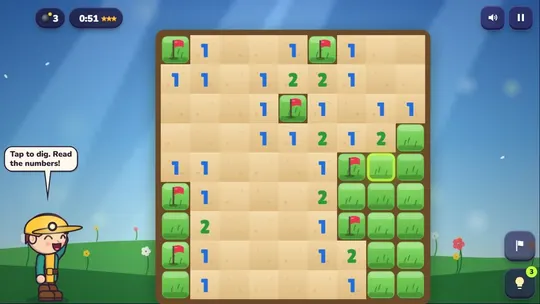
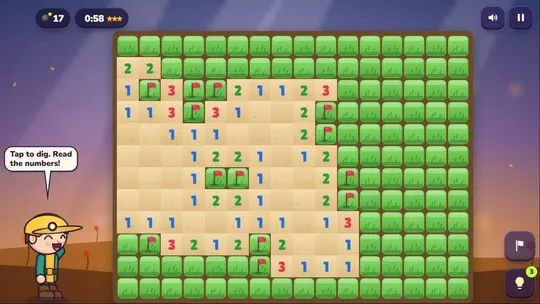
Mine Seeker is our free mine-finding logic puzzle, played in a sunny field with Kit the explorer. Flag the mines you find, tap a number to dig around it once its mines are flagged, and every board can be solved by logic — no forced guesses. Try a quick small field first, then work up to the big ones.
| Size | Board | Mines | Share of cells with a mine |
|---|---|---|---|
| Easy | 9×9 | 10 | about 12% |
| Medium | 12×16 | 30 | about 16% |
| Hard | 16×20 | 60 | about 19% |
| Expert | 16×30 | 99 | about 21% |
The bigger boards are not only larger but also more crowded, so the patterns above appear more often — and matter more.
A few features worth knowing:
- A safe start. Your first dig is always safe and opens an area, and the board is checked by a built-in solver so you never face a coin-flip guess.
- Flagging on any device. Long-press, use the flag-mode button (F) or right-click to flag a mine.
- Logical hints. A hint (H, three per board) shows a cell that logic proves safe — a good way to discover which pattern you missed.
- A daily board. The daily Medium board is the same for everyone, with best times for every size and up to three stars per board.
Enjoy pure logic? Our guide on how to solve sudoku uses the same step-by-step proof.
FAQ
What does a number mean in minesweeper?
A number shows how many mines are in the eight cells surrounding it, counting diagonals. A 2, for example, means exactly two of its neighbours hide mines and the rest are safe. A cell with no number has no mines around it, which is why digging one opens a whole area of the board at once.
Where is the best place to click first in minesweeper?
The middle of the board is usually best because it is more likely to open a large empty area. In most modern versions the first click is always safe. In Mine Seeker, your first dig is always safe and opens an area, so you can begin reading numbers straight away instead of guessing.
What is chording in minesweeper?
Chording is tapping a number that already has the right number of flags around it, which instantly reveals all its other neighbouring cells. It speeds up play but only works when your flags are correct. In Mine Seeker, if the flags around a number don't match, its neighbours wiggle instead of opening.
Can every minesweeper board be solved without guessing?
Classic random boards sometimes force a 50-50 guess. Some games, such as Mine Seeker, only create boards that can be solved by logic alone. Its solver must be able to clear each board from your first dig using logic, or the board is thrown away and built again before you see it.