

Guides
How to Solve Sudoku: 7 Techniques from Beginner to Expert
How to solve sudoku with seven techniques: scanning, naked and hidden singles, pencil marks, pairs, pointing and X-Wing, with clear examples.
By GamesYap Team6 min read
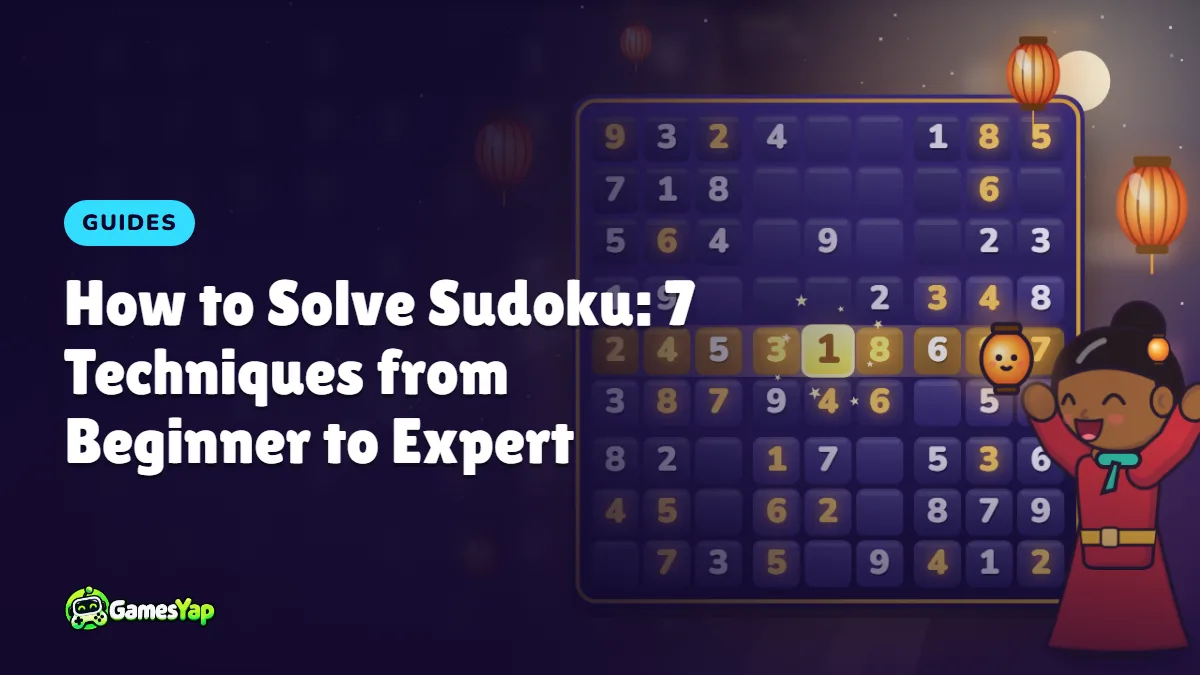
Sudoku is a logic puzzle, not a maths puzzle: you never add anything up. The rule is simple — fill the 9×9 grid so that every row, every column and every 3×3 box contains the digits 1 to 9 exactly once. A well-made sudoku has exactly one solution and can always be solved by logic alone, with no guessing.
The trick is knowing where to look. These seven techniques show you how to solve sudoku puzzles from your first easy grid all the way to expert level.
1. Scanning (cross-hatching)
Pick a digit — say 5 — and look at one 3×3 box. Then check the rows and columns that pass through that box: every row and column that already contains a 5 rules out its cells in the box. Often only one empty cell remains, and the 5 goes there.
Scanning each digit across all nine boxes solves most of an easy puzzle.
2. Naked singles
Look at one empty cell and list which digits are still possible, checking its row, column and box. If only one digit is left, that is the answer. Naked singles appear constantly once a puzzle is half filled.
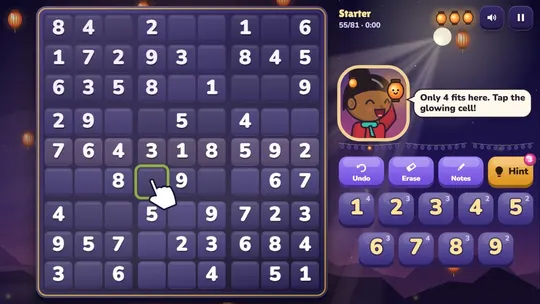
Here is a real example from the screenshot below. The highlighted cell sits in a row that already holds 6, 7, 8 and 9, a column that holds 2, 3, 5, 8 and 9, and a box that holds 1, 3, 5, 8 and 9. Put those together and every digit except 4 is ruled out, so the cell must be 4.
3. Hidden singles
Sometimes a cell has several candidates, but one of them can only go in that cell within its row, column or box. For example, if the digit 7 fits in just one cell of a row, it must go there — even though that cell could otherwise hold a 2 or a 4.
The difference matters: a naked single asks "which digits can go in this cell?", while a hidden single asks "where can this digit go in this row, column or box?". Strong solvers switch between both questions all the time.
4. Pencil marks (candidates)
For medium and hard puzzles, write small candidate digits in every empty cell. It feels slow, but it turns the puzzle into a visible logic problem and makes the next techniques possible. Whenever you place a digit, erase it from the candidates in the same row, column and box.
5. Naked pairs and triples
If two cells in the same row (or column or box) have exactly the same two candidates — say {3, 8} — then 3 and 8 must go in those two cells, in some order. You can remove 3 and 8 from every other cell in that row. The same works for three cells sharing three candidates.
6. Pointing and box/line reduction
If, inside one box, all the candidates for a digit lie in a single row, that digit must be in that row within the box. So it cannot appear in that row anywhere outside the box — erase it there. The reverse also works: if a digit in a row is confined to one box, remove it from the rest of that box.
7. X-Wing
For expert puzzles: if a digit appears as a candidate in exactly two cells in each of two rows, and those cells line up in the same two columns, the digit must sit at opposite corners of that rectangle. You can remove it from every other cell in those two columns.
A good solving routine
- Scan every digit through every box.
- Fill obvious naked and hidden singles.
- Add pencil marks once you get stuck.
- Look for pairs, then pointing, then X-Wings.
- After every placed digit, go back to step 2 — easy moves appear again.
Above all, never guess. If you are stuck, a technique is waiting to be spotted.
Which techniques each level needs
Puzzle makers rate difficulty differently, but this is a useful rough guide:
| Level | Techniques you usually need |
|---|---|
| Starter and easy | Scanning, naked and hidden singles |
| Medium | Pencil marks and naked pairs |
| Hard | Triples, pointing and box/line reduction |
| Expert | All of the above, plus patterns like X-Wing |
If a puzzle feels impossible, it may simply be a level above the techniques you know. Step back a level, practise the next technique there, then return.
Common mistakes
- Placing a digit because it "probably" goes there. One wrong digit can spread errors across the grid. Only place a digit when you can say why nothing else fits.
- Forgetting to update pencil marks. Every placed digit removes candidates from its row, column and box. Old marks hide easy singles.
- Scanning only rows. Boxes and columns hold just as many singles, and beginners often miss them.
- Staring at one corner. If one area is stuck, move to another box. Progress elsewhere often unlocks the first area.
Practise with a calm puzzle
Lantern Sudoku is our free sudoku game with freshly generated puzzles, each with exactly one solution. Climb a five-step path from a quick Starter puzzle to Expert, use pencil notes, earn up to three stars and beat your best times. It runs in the browser on phone, tablet and computer.
How the techniques above fit its tools:
- Starter puzzles can be solved with singles only, so they are ideal for practising scanning.
- Notes (N) pencil in small candidate numbers for pairs, pointing and X-Wings.
- Three lantern lives. A wrong number costs one life, and clashing numbers glow red. Treat each life as a reminder to place only digits you can prove.
- Hints and undo. A hint (H) fills one cell, up to three per puzzle, and Undo (Z) takes back any move.
- The Daily puzzle is the same for everyone each day, and your current puzzle is saved, so you can continue later.
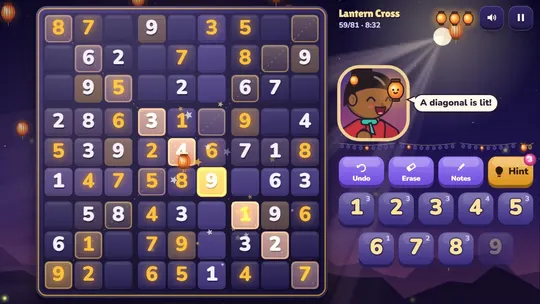
- Lantern Cross opens after your first Medium solve. Both long diagonals must also hold 1 to 9, which gives you extra lines to scan.
Like pure logic puzzles? Our guide to minesweeper patterns uses the same "prove it before you play it" thinking.
FAQ
What is the easiest way to start a sudoku?
Start by scanning: pick one digit at a time and look at each 3×3 box to see where that digit can still go. The digits that already appear most often on the grid are the easiest to place first, so begin with them.
Do you ever need to guess in sudoku?
No. A properly made sudoku has exactly one solution that can be reached by logic alone. If you feel you must guess, look for a technique you have missed, such as a hidden single, a naked pair or pointing candidates.
What are pencil marks in sudoku?
Pencil marks, also called candidates or notes, are the small digits you write in an empty cell to show which numbers could still go there. They make harder logic like pairs, pointing and X-Wing visible. Remember to erase a candidate from the same row, column and box whenever you place a digit, or old marks will mislead you.
How long does it take to solve a sudoku?
It varies a lot from player to player. An easy sudoku often takes somewhere around five to fifteen minutes, while expert puzzles can take thirty minutes or more. Speed comes from practice with scanning and singles, which handle most of every puzzle, and from keeping your pencil marks tidy.
