

Guides
Mahjong Solitaire Rules and Strategy: How to Clear More Boards
How to play mahjong solitaire: which tiles are free, matching pairs, flowers and seasons, and the strategies that clear more boards without shuffling.
By GamesYap Team6 min read

Mahjong solitaire is a single-player tile-matching puzzle that uses the beautiful tiles of the classic Chinese game. The tiles are stacked in layers — often in the famous turtle shape — and you remove them in matching pairs until the board is empty. It looks relaxing, and it is, but a little planning turns many "stuck" boards into wins.
The goal
Clear every tile from the board by removing identical pairs. When no matching pair of free tiles remains, the board is blocked; most games then let you shuffle the remaining tiles.
What makes a tile free?
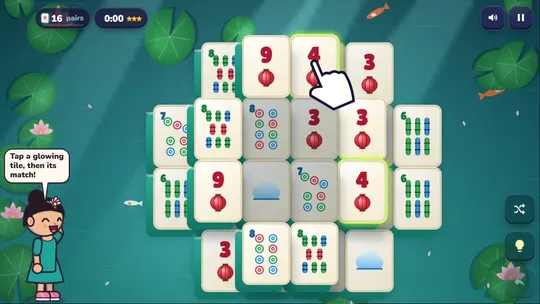
You can only pick a tile that is free:
- nothing lies on top of it, and
- its left side or its right side is open (no tile directly touching it there).
Tiles in the middle of a row, or under another tile, cannot be picked until their neighbours are removed.
Matching rules
Most tiles must match exactly — the same suit and number (for example two "5 of bamboo") or the same honour tile (winds and dragons). Two special groups match more loosely:
- Flowers: any flower matches any other flower.
- Seasons: any season matches any other season.
The classic tile set
A traditional set has 144 tiles. Knowing how many of each exist helps you plan, because you always know how many copies are still hidden.
| Group | Tiles | Copies of each |
|---|---|---|
| Three suits (dots, bamboo, characters) | 1 to 9 in each suit | 4 |
| Winds | East, South, West, North | 4 |
| Dragons | Red, green, white | 4 |
| Flowers | 4 different pictures | 1 — any flower matches any flower |
| Seasons | 4 different pictures | 1 — any season matches any season |
Many modern games, including ours, redraw the tiles with their own symbols, but the idea stays the same: most tiles come in sets of four, while flowers and seasons are matched loosely within their group.
Strategies that clear more boards
- Open the long rows first. Tiles at the ends of the longest horizontal rows are blocking the most other tiles. Freeing them gives you more choices later.
- Uncover stacks early. A tile on top of a stack hides tiles beneath it. Removing high tiles opens new matches; removing flat edge tiles often does not.
- Look before you match. If three or four identical tiles are free, think about which pair to take. Keep the one that frees the most useful tile for later.
- Watch for "buried twins". If two identical tiles sit on top of each other, the lower one can only be freed by removing the upper one with a different partner. Plan that partner early.
- Don't rush the easy pairs. Matching every free pair as soon as you see it is the most common cause of a dead end.
- Count the fourth tile. Each normal tile appears four times. If two are already gone, the last two must be matched with each other — make sure they don't end up stuck under one another.
A worked example: three free twins
Say three identical tiles are free at once:
- Tile A sits at the end of the longest row and blocks a whole line of tiles.
- Tile B sits on top of a tall stack.
- Tile C sits at the edge of a short, flat row and blocks nothing.
Match A with B. Removing A opens the long row, and removing B uncovers the tile below. Tile C costs you nothing by staying, and the fourth copy will turn up later to match it. Matching C first would waste a pair on a tile that was never in anyone's way.
Common mistakes
- Matching the first pair you see. Easy pairs are often the ones that cost you nothing to keep for later.
- Ignoring the tall stacks. The centre of most layouts is the highest point, and its lower layers hide many tiles.
- Forgetting the hidden copies. Before you match two of a kind, ask where the other two are. If one is buried under its twin, plan its partner now.
- Shuffling too early. A shuffle may save a stuck board, but first check every free tile again — a missed pair is common.
Play a board that can always be won
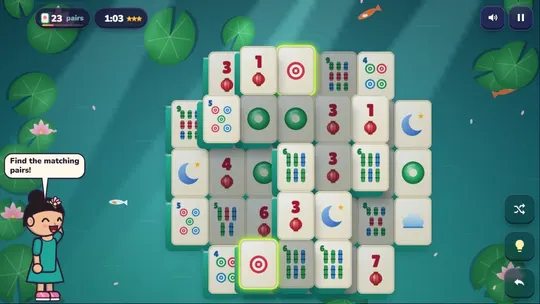
In Lotus Mahjong, our free mahjong solitaire game, every deal is built so that a winning path exists, and the Shuffle button keeps it that way. Walk the Lotus Path of 24 boards on a living lotus pond with Lian as your guide, or play a daily board — in the browser on phone, tablet or computer.
How its features fit the mahjong solitaire strategy above:
- Free tiles stand out. Free tiles are bright and blocked tiles look darker, so you can see your real options at a glance.
- Hint, Undo and Shuffle are always free. The hint (H) shows a good pair to take, Undo (U) lets you test which twin to keep, and Shuffle (S) re-deals the tiles left so the board can still be won.
- Boards that grow with you. The Lotus Path runs through four chapters, from the 32-tile Lotus Bud to the 144-tile Grand Lotus. Blossoms and seasons appear on the 144-tile boards.
- Stars for speed. Clearing a board fast earns more stars, but planning still saves the most time: every dead end costs a shuffle or several undos.
- A daily board that is the same for everyone.
Enjoy calm puzzles like this? See our list of relaxing games online.
FAQ
How do you know which mahjong tiles you can take?
A mahjong solitaire tile can be taken when nothing is stacked on top of it and its left or right side is free. Most games highlight free tiles or let you tap only those, so you can see your options at a glance. In Lotus Mahjong, free tiles are bright and blocked tiles look a little darker.
Do all flower tiles match each other?
Yes. In mahjong solitaire any flower tile matches any other flower tile, and any season tile matches any other season tile, even though their pictures differ. All other tiles must match exactly. In a classic set there is only one of each flower and each season, so this looser rule is the only way they can ever be paired.
Can every mahjong solitaire board be solved?
Not with a random shuffle — some deals have no solution. Games such as Lotus Mahjong build their boards so that a winning path always exists, and their shuffle keeps the board solvable. Lotus Mahjong builds each deal backwards from the full layout, removing matching pairs one by one, so a winning order always exists.
What is the best strategy for mahjong solitaire?
Free the tiles that block the most others first: the ends of long rows and the tops of tall stacks. Avoid matching easy pairs automatically, and plan ahead when three or four identical tiles are free at the same time.
