Guides
2048 Strategy: How the Corner Method Gets You to Bigger Tiles
The best 2048 strategy explained: keep your biggest tile in a corner, build a chain along one edge, avoid the fourth direction and plan merges ahead.
By GamesYap Team6 min read
In 2048-style puzzles every swipe slides all tiles on a 4×4 board, two equal tiles merge into one bigger tile, and a new small tile appears after every move. The game ends when the board is full and nothing can merge. Random swiping gets you surprisingly far — but one simple system, the corner method, gets you much further.
This guide explains that 2048 strategy step by step: why it works, how to build the chain, which mistakes end most games, and how to use it in our own number-fusion puzzle.
Why random swiping stops working
A 4×4 board has only 16 cells, and every move adds a new tile. Early on, small tiles meet all the time. The trouble starts in the middle game, when a few large tiles are scattered across the board: they cannot meet, and each one blocks a cell the small tiles need. Most games are lost to clutter, not bad luck.
The corner method gives the board a shape. Your largest tile lives in one corner, the next-largest line up beside it, and small tiles are worked on in the open space on the far side.
The corner method
- Choose a corner — say bottom-left — and keep your biggest tile there for the whole game.
- Use only three directions most of the time: down, left and right (for a bottom-left corner). Avoid up, because it pulls the big tile out of its corner.
- Keep the bottom row full. A full row cannot shift sideways when you swipe left or right, so your big tiles stay put.
- Build a chain. Arrange tiles in decreasing order along the bottom row — 256, 128, 64, 32 — so each new merge can roll into the next one, like a snake running from the corner.
Of the three allowed directions, two do most of the work. With a bottom-left corner, down and left are your main swipes; right is the backup you use only when the bottom row is full.
Building the chain: a worked example
Imagine your bottom row reads 128, 64, 32, 8 from left to right, and another 8 sits directly above the last cell.
- Swipe down. The two 8s fuse into a 16 in the fourth cell, and the row reads 128, 64, 32, 16.
- Build another 16 in the row above, right over the end of the chain, and swipe down again. The bottom row becomes 128, 64, 32, 32.
- One swipe left fuses the two 32s into a 64, which now sits next to the other 64. Another left swipe makes a 128 beside your corner 128 — and one more makes 256.
That cascade is the point of the chain: each step is half the value of the one before it, so a single merge at the far end can roll all the way back into the corner.
Planning merges
- Merge towards the corner. When two equal tiles appear, merge them on the side closest to your chain.
- Don't merge small tiles everywhere. Scattered small merges fill the board with mid-size tiles that never meet.
- Watch where the new tile will appear. A new tile always lands on an empty cell; keeping empty cells away from your corner protects your chain.
When you must press the "bad" direction
Sometimes no safe move exists. If you have to swipe up, do it when the bottom row is full so the corner tile cannot move — and swipe back down immediately.
Common mistakes
| Mistake | What happens | Better habit |
|---|---|---|
| Chasing a merge in the middle of the board | The big tile leaves its corner | Merge only towards your chain |
| Leaving one empty cell in the corner row | A new small tile drops in front of your big tile | Keep the edge row full |
| Building the chain out of order (64, 128, 32) | Merges cannot roll into the corner | Keep values falling from the corner outwards |
| Swiping quickly without looking | Avoidable blocks and lost corners | Pause before each swipe in the mid game |
2048 rewards patience. Before each swipe, ask where your biggest tile will be afterwards and where the new tile can land.
A gentler twist on the idea
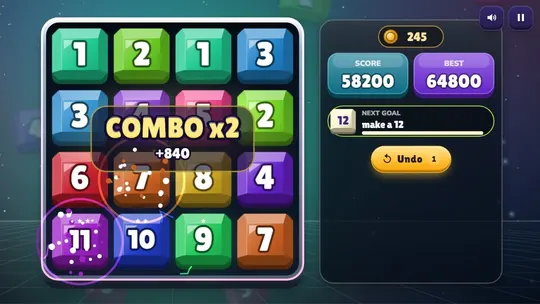
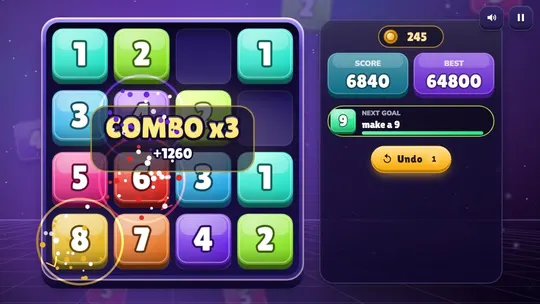
Fuse Tiles is our free number-fusion puzzle in the same family: every swipe slides the board and matching energy tiles fuse into brighter ones (1 + 1 → 2, 2 + 2 → 3 …). It has a 30-stage journey with clear goals and three stars per stage, a daily challenge and an Endless mode, and the corner method works beautifully there too.
Because each fusion adds one level, the numbers stay small: an 11 tile in Fuse Tiles equals a 2048 tile in the classic game. Here is how the 2048 strategy maps onto its real features:
- New tiles. After each swipe a new tile appears on an empty cell — usually a 1, sometimes a 2 — so protect the cells near your corner.
- Combos. Several fusions in one swipe score bonus points, and an ordered chain often produces them on its own.
- Journey goals. Stages ask for a certain tile or score before your swipes run out, and fewer swipes earn more stars. A tidy corner wastes fewer swipes.
- Undo. Your first new top tile of 5 or more unlocks Undo (button, Z or U). Save it for a bad new tile in your corner row.
Prefer physics? In Jelly Jar you drop squishy jellies into a jar and matching sizes melt into bigger ones — the same "keep big pieces together" thinking applies. Our drop and merge puzzle tips cover that style in more detail.
FAQ
What is the best strategy for 2048?
Keep your largest tile in one corner, use only three swipe directions so it never leaves, keep the edge row full and build a descending chain of tiles towards the corner. Merges at the small end of the chain can then roll back towards the corner.
Is 2048 based on luck?
Partly. New tiles appear on random empty cells, but good planning with the corner method makes the outcome depend far more on skill than on luck. Keeping empty cells away from your corner limits how much a badly placed new tile can hurt you.
Why does my game end so quickly?
Usually because the big tile left its corner or the board filled with scattered small tiles. Merging towards one corner and avoiding the fourth direction keeps space free for longer. If your chain is out of order, merges cannot cascade either.
What should I do if my big tile leaves the corner?
Stay calm and keep your usual directions. Try to merge the small tile that slipped into the corner until it can join its neighbours, then slide the big tile back. Switching to a brand-new corner mid-game usually costs more moves than repairing the old one.
Can I play a 2048-style game online for free?
Yes. Fuse Tiles on GamesYap is a free number-fusion puzzle that runs in the browser on phones, tablets and computers, with no download. It has a 30-stage journey, a daily challenge and an Endless mode, and the board is saved, so you can continue an Endless game later.