

Guides
Car Parking Puzzle Tips: How to Free the Red Car in Fewer Moves
Car parking puzzle tips for unblock-the-car games: map the blocker chain, work backwards from the exit, handle trucks, count moves and use hints wisely.
By GamesYap Team6 min read
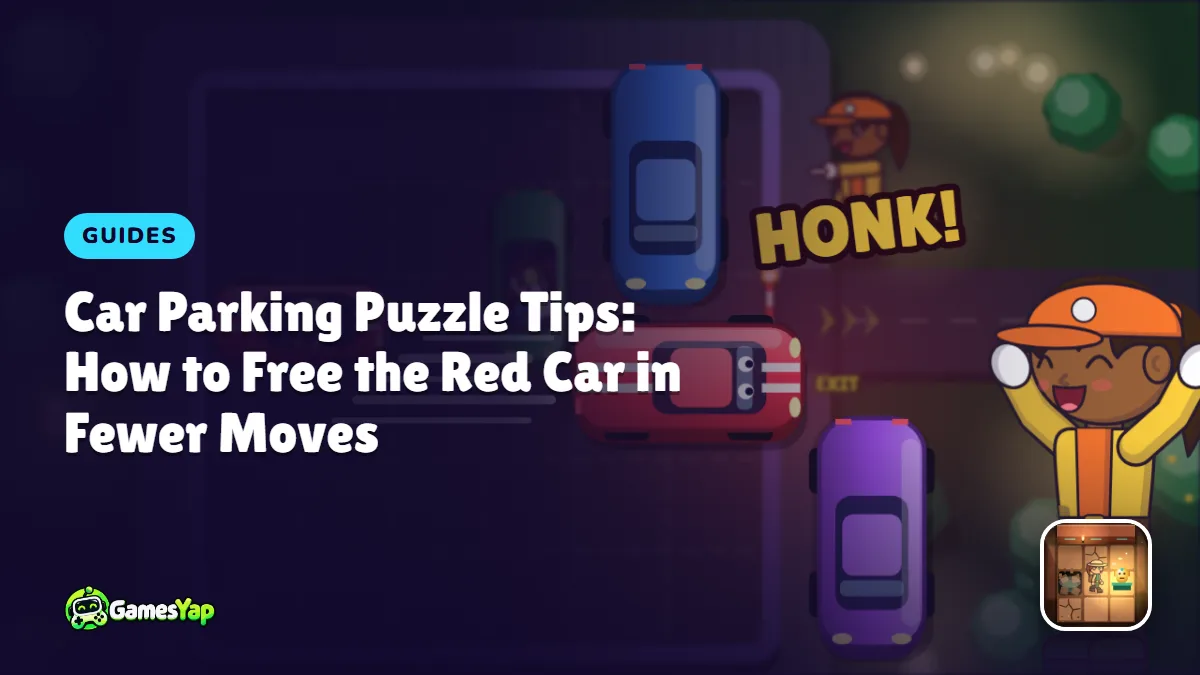
A car parking puzzle looks simple: slide the cars out of the way and drive the red car through the exit. The trouble is that every car you move blocks something else. This guide explains the logic that solves these unblock puzzles, how to work backwards from the exit, and how to finish in the fewest moves, using Honk Out, our free parking lot puzzle, as the example.
The rules of the unblock puzzle
Nearly every car parking puzzle uses the same rules:
- The board is a small grid, usually 6 by 6.
- Cars are two cells long and trucks are three cells long.
- Every vehicle can only slide forwards and backwards along its own lane. Nothing turns, and nothing moves sideways.
- One special car, usually red, sits in the exit row. You win when it drives out through the gate.
- A move normally counts as one slide of one vehicle, however far it travels.
Because vehicles never turn, each one has only a few possible positions. That makes the puzzle completely logical: there is no luck, and every level has a solution.
Step 1: map the blocker chain
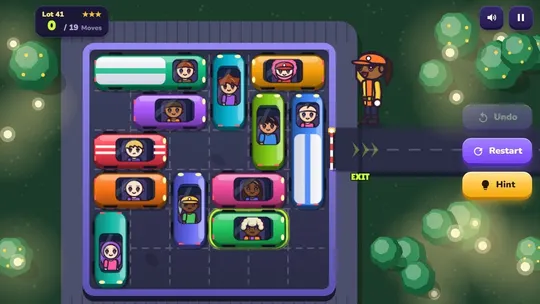
The key technique is to ask "who is in the way?" again and again until you reach a car that can move freely.
- Look along the exit row. List every vehicle standing between the red car and the gate.
- For each blocker, ask where it could go. A vertical car in the exit row must slide up or down far enough to clear the row.
- Check what stops it. If the space it needs is occupied, that vehicle becomes the next blocker in the chain.
- Repeat until you find a vehicle that can already move. That is usually your first move.
This is working backwards from the exit, and it is far faster than sliding random cars and hoping.
Step 2: choose the right direction
Most blockers in the exit row can clear it in two ways: up or down. Picking the wrong direction is the most common reason a level drags on.
- Count the cells needed. A two-cell car standing on the exit row may need to move one or two cells; a three-cell truck may need three. Check which direction requires fewer other cars to move.
- Look for dead ends. If moving a blocker up would need a truck that has nowhere to go, try down instead.
- Trucks first. Trucks take up more room and have fewer free positions. Plan their path first, then fit the cars around them.
Step 3: accept moves that look backwards
Many beginners refuse to move the red car away from the exit or to slide a car into a "worse" spot. Harder puzzles often need exactly that:
- Sometimes the red car must back up so that a vertical car can slide down past it.
- Sometimes a car has to move out of the way and back again later, once a third car has shifted.
- A temporary mess is fine if it opens the key lane.
If you are stuck, look for a vehicle you have never moved yet. The solution often hides there.
Counting moves and chasing par
Many parking puzzles give you a target number of moves, often called par, and reward you for matching it.
| Habit | Why it saves moves |
|---|---|
| Slide each car as far as it needs in one drag | One drag counts as one move |
| Plan the chain before touching anything | Avoids moves you later undo |
| Don't shuffle the same car back and forth | Each shuffle is a wasted move |
| Undo mistakes right away | Keeps the move count honest |
A good routine is to solve a level once in any number of moves, then replay it aiming for par. The second time, you already know the key idea.
Applying these tips in Honk Out
Honk Out has 64 hand-picked lots in four chapters, growing from a two-move warm-up to jams that need 28 moves. Every lot was checked by a solver, so every one has a perfect solution. Here is how its real mechanics match the advice above.
- Moving. Drag a car or truck along its lane with your finger or mouse. On a keyboard, Tab picks a vehicle and the arrow keys or WASD move it; several steps of the same vehicle count as one move.
- One drag, one move. However far a vehicle slides, a single drag is a single move, so slide each car all the way it needs to go.
- Stars and par. The goal card and the HUD show your moves against the perfect number. Match it for three stars; up to one and a half times par earns two stars, and anything else earns one.
- Undo and Restart. Undo is unlimited (button, Z or U) and Restart is free (button or R), so experiment freely.
- Hints. The free Hint button, or H, shows the next perfect move. A hinted lot can earn at most two stars, so try mapping the blocker chain yourself first.
Valet Rush
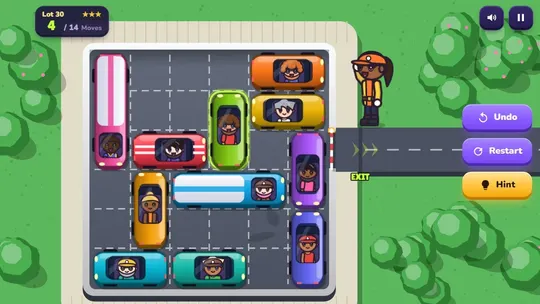
When you finish the main lots, try Valet Rush: freshly generated lots against a two-minute clock. Each red car you free adds 15 seconds, and each new lot needs a few more moves than the last. There are no hints here, so the blocker-chain method really pays off.
If you like this kind of thinking, Relic Rooms and our box pushing puzzle guide use the same plan-before-you-move logic. For other calm brain teasers, try the water sort puzzle tips or browse our brain games.
FAQ
How do you solve a car parking puzzle?
Start at the exit and work backwards. List every vehicle between the target car and the gate, then ask where each one could move and what is stopping it. Keep following that chain of blockers until you find a vehicle that can already move, and make that move first. Repeat until the exit row is clear and the target car can drive out.
Why can't cars move sideways in parking puzzles?
In unblock-style parking puzzles, each vehicle can only slide forwards and backwards along its own lane, like a real car that cannot drive sideways. This rule is what makes the puzzle work. Because every vehicle has only a few possible positions, the puzzle becomes pure logic, and each level can be solved by careful planning rather than luck.
What is the best way to solve the puzzle in fewer moves?
Plan the whole blocker chain before moving anything, then slide each vehicle as far as it needs in a single drag, because one drag usually counts as one move. Avoid moving the same car back and forth, and handle trucks first, since they have the fewest free positions. Replaying a solved level often reveals a shorter route.
Do hints cost anything in Honk Out?
No. Hints in Honk Out are free, along with unlimited undo and restarts. A hint shows the next perfect move. The only catch is that a lot solved with a hint can earn at most two stars, so if you want three stars, try to work out the blocker chain on your own first.
How many levels does Honk Out have?
Honk Out has 64 lots in four chapters on a lot map. They start with a gentle two-move warm-up and build up to jams that need 28 moves, and every lot has a perfect solution checked by a solver. After the main lots, the timed Valet Rush mode serves freshly generated lots for as long as your clock lasts.

