

Guides
Pipe Connect Puzzle Tips: Rotate Tiles with Logic, Not Luck
Pipe connect puzzle tips: how rotating tiles work, why corners and edges come first, dead-end and loop rules, and counting twists to finish in fewer moves.
By GamesYap Team6 min read

A pipe connect puzzle gives you a grid of scrambled tiles, each holding a piece of path, and asks you to rotate them until everything links up into one network. Tapping tiles at random rarely works on larger boards. This guide shows the logic that solves these rotating-tile puzzles quickly: which tiles to fix first, the rules that rule out wrong turns and how to finish in fewer moves, using Tile Twist, our calm night-garden puzzle, as the example.
How rotating tile puzzles work
Almost every pipe connect puzzle uses the same building blocks. Each tile shows a shape with openings on some of its four sides:
| Tile | Openings | Distinct rotations |
|---|---|---|
| Dead end | 1 | 4 |
| Straight | 2, opposite | 2 |
| Corner (elbow) | 2, next to each other | 4 |
| T-junction | 3 | 4 |
| Cross | 4 | 1 (never needs turning) |
You can only rotate tiles, not move them. A connection exists when two neighbouring tiles both have an opening on their shared side. The goal is usually to connect every tile into one network from a source, with no openings left dangling.
Rule 1: the edge of the board is a wall
The most useful clue is the border. A pipe can never point off the board, because nothing is there to connect to.
- Corner tiles touch two walls, so they have very few legal rotations. A corner elbow on a board corner has exactly one correct position.
- Edge tiles touch one wall. A T-junction on an edge has exactly one legal rotation: its closed side must face the wall.
- Straights on an edge must run parallel to the edge.
So always start on the border and work inwards. Each locked edge tile then becomes a new "wall" or a new connection for its neighbours.

Rule 2: dead ends must point at a neighbour
A dead-end tile has a single opening, so it can only connect one way. That opening must face a neighbour that can connect back.
- On a corner, a dead end has only two possible directions.
- If one neighbour is already locked with its side closed, the dead end can't point there.
- Two dead ends should never point at each other unless they are the whole puzzle, because together they would form a tiny island cut off from everything else.
Rule 3: everything must join one network
In most of these puzzles, every tile must connect to the source in one single network.
- No islands. If a group of locked tiles forms a closed shape with no route to the rest, something in it is wrong.
- No loops (in many puzzles). If the puzzle is built as one branching path without cycles, any rotation that closes a ring is wrong. This rules out many choices in the middle of the board.
- Follow the flow. Puzzles that light up connected tiles, like Tile Twist, show you which tiles already join the source. Extend that lit network one tile at a time.
A step-by-step solving method
- Fix the four corners of the board first.
- Work along each edge, using the corners as anchors.
- Fix every dead end whose direction is forced.
- Look for tiles with one legal rotation left after their neighbours are set; lock them in.
- Grow from the source, checking that each new connection doesn't create an island or a loop.
- Leave the centre for last. By then most of its neighbours are fixed, so its rotation is usually obvious.
Counting twists to save moves
Many pipe puzzles count your rotations, and some limit them.
- Know your direction. If tiles turn one way only, for example clockwise, then a tile that needs a quarter turn the "other way" actually needs three taps. Count before you tap.
- Straights repeat. A straight looks the same after a half turn, so it never needs more than one tap from a wrong position.
- Plan, then tap. Every exploratory twist on a tile you haven't solved yet is a move you may have to undo with more twists later.
Applying these tips in Tile Twist
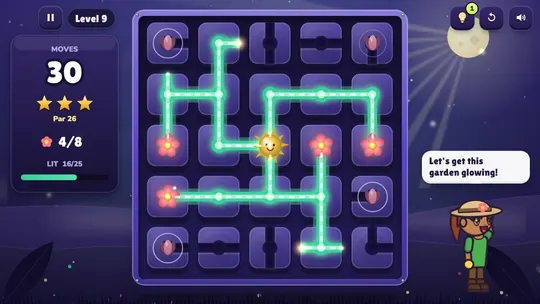
Tile Twist asks Rosa the gardener's question: can you twist the path tiles so sunlight flows from the smiling sun to every tile and every flower bud blooms? Here is how its real mechanics match the advice above.
- Twisting. Tap or click a tile to twist it a quarter turn clockwise; each twist uses one move. On a keyboard, move the cursor with the arrows and twist with Space or Enter.
- Winning. Every tile must be lit, connected to the sun, with no open pipe ends. That means the border rule and the dead-end rule both apply exactly.
- Flower buds sit on the dead-end tiles, so each bud tells you where a branch of the path ends.
- One network, no loops. Each garden is built as a single branching path from the sun, so a twist that closes a ring is always wrong.
- Boards and chapters. There are 36 levels in six chapters, growing from 3×3 warm-ups to 7×7 gardens. In the last chapter, Mirror Lagoon, twin tiles marked with the same gem always turn together, so check what a twist does to both before you tap.
Stars, hints and retries
The goal card shows the blooms, your move budget and the star targets; fewer twists earn more stars, and lighting several blooms at once makes a combo. The bulb gives one free hint per level, which fixes one tile, and if you run out of moves you can take a free retry or restart. A new daily puzzle, the same garden for every player, appears each day.
If you enjoy step-by-step logic, try Honk Out with our car parking puzzle guide, or practise grid deduction with the minesweeper strategy patterns. Find more in our puzzle games.
FAQ
How do you solve a pipe connect puzzle?
Start with the tiles that have the fewest legal rotations: corners and edges of the board, where pipes cannot point outwards, and dead ends, which must point at a neighbour. Lock those in, then work inwards, fixing any tile left with only one possible rotation. Keep every tile joined to one network from the source, and avoid creating isolated islands.
Why should you start with corners and edges?
Because a pipe can never point off the board. A tile on a corner touches two walls and a tile on an edge touches one, so most of their rotations are illegal. That usually leaves just one or two choices. Once they are fixed, they act as new anchors for their neighbours, and the rest of the board becomes much easier.
What are dead-end tiles in pipe puzzles?
Dead-end tiles have only one opening, so they can connect in just one direction. That opening must face a neighbour that has an opening back. They often mark the ends of branches, which is why Tile Twist puts its flower buds on them. Fixing dead ends early is a quick way to remove wrong choices from the board.
How do you finish a pipe puzzle in fewer moves?
Work out a tile's correct position before you tap it, instead of experimenting. If tiles only rotate one way, count the taps: a quarter turn backwards takes three taps forwards. Remember that straight pieces look identical after a half turn, so they need at most one tap. Solving the border and dead ends first avoids extra twists later.
What are twin tiles in Tile Twist?
Twin tiles appear in Mirror Lagoon, the sixth chapter of Tile Twist, covering levels 31 to 36. Two tiles marked with the same gem always turn together, and the double turn counts as a single move. Before each twist, check what it does to both tiles, because fixing one twin can turn its partner out of place.

