Guides
9 Chess Checkmate Patterns Every Beginner Should Know
Learn the chess checkmate patterns every beginner needs: back-rank mate, rook ladder, king and queen, king and rook, smothered mate, scholar's mate and more.
By GamesYap Team7 min read
Knowing the rules of chess is one thing; knowing how to finish a game is another. Strong players do not calculate every checkmate from scratch — they recognise patterns they have seen many times before. This guide covers nine chess checkmate patterns every beginner should know, from the basic mates that win endgames to the classic traps that end games in four moves.
You can practise most of them for free in Chess Citadel, whose 12-step Puzzle Path teaches classic mates, from simple mates in one to mates in two. If you are brand new to chess, start with our chess for beginners guide.
A quick reminder: what is checkmate?
Checkmate happens when a king is in check — attacked — and has no legal way out. A king can escape check in three ways:
- Move to a safe square.
- Block the attack by putting a piece in between.
- Capture the attacking piece.
If none of these is possible, it is checkmate and the game is over. Every pattern below is really about taking away those three escapes. Squares are written in standard notation: files a–h from left to right, ranks 1–8 from White's side.
1. Back-rank mate
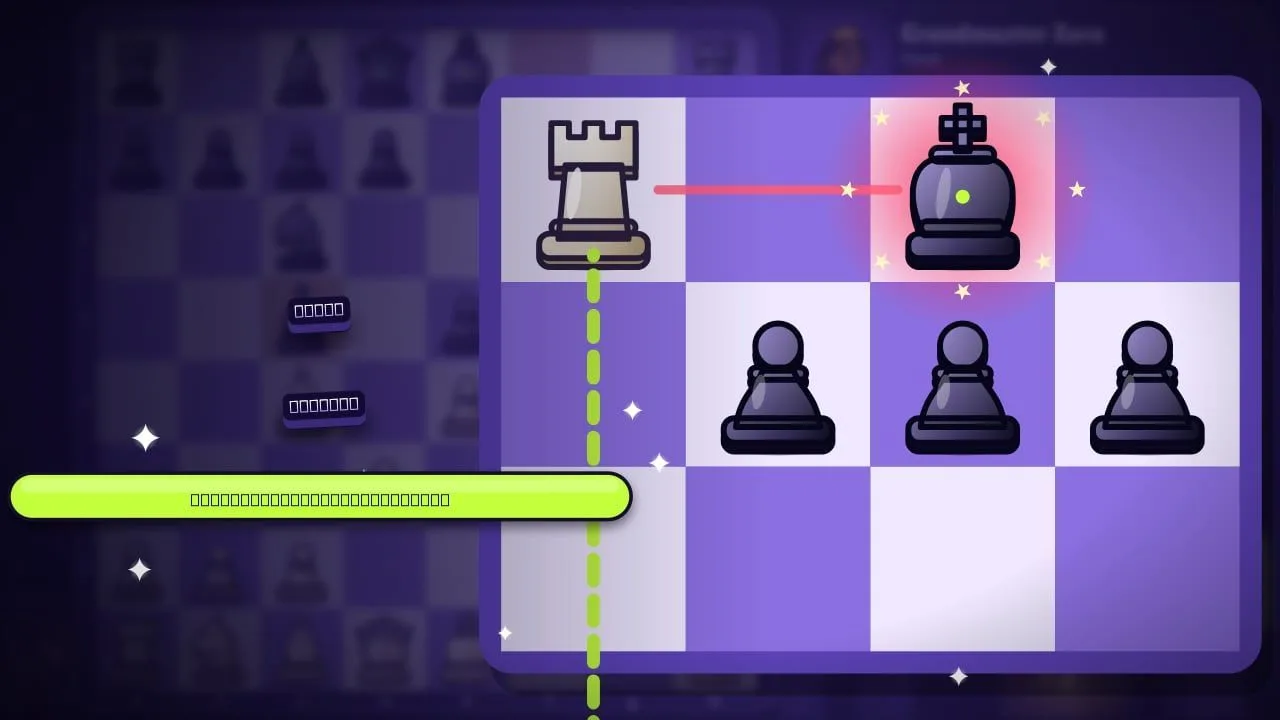
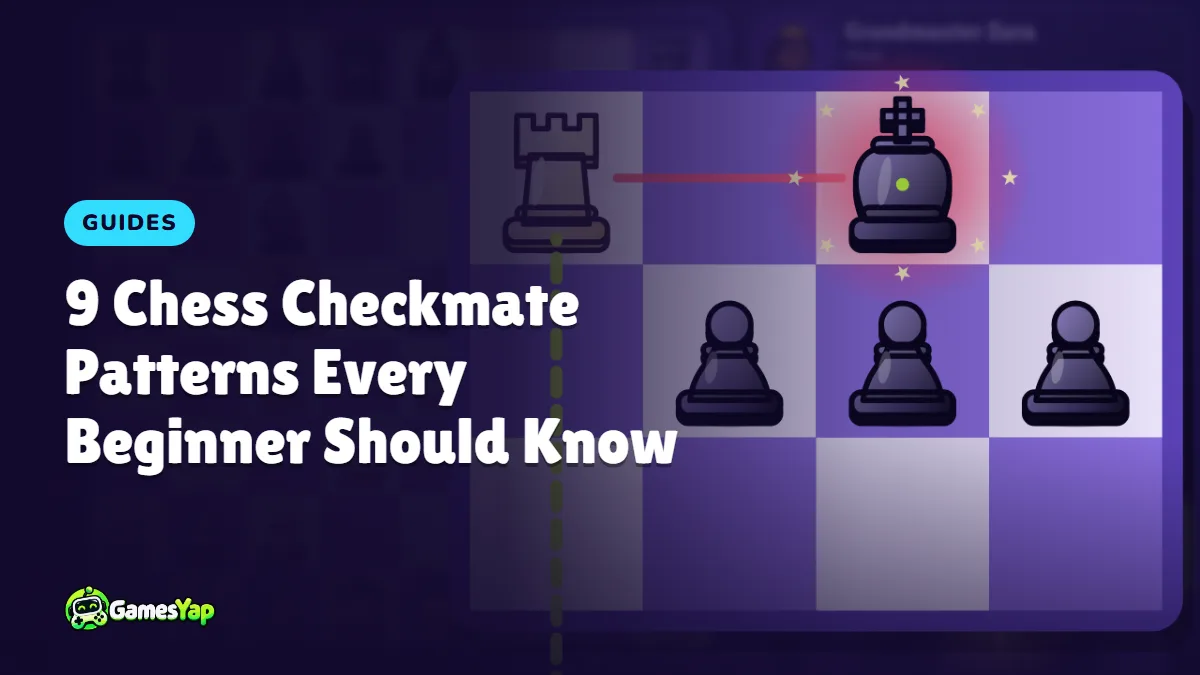
This is the most common checkmate in real games. A king sits on its back rank behind a wall of its own pawns — say, Black's king on g8 with pawns on f7, g7 and h7. A white rook or queen lands on the eighth rank with check, and the king has nowhere to go: its own pawns block every escape.
How to use it: look for an open file that leads to your opponent's back rank, especially when their rooks have left it.
How to avoid it: give your king a "window" by moving one of the pawns in front of it — for example h3 or h6 — once the opening is over.
2. The rook ladder (two-rook mate)
Two rooks can checkmate a lone king without any help from your own king. They take turns: one rook checks the king along a rank, the other cuts off the next rank, and step by step they walk the king to the edge of the board like climbing a ladder. When the king reaches the edge, the final check is mate.
Key idea: keep the rooks far away from the enemy king so it cannot attack them, and move them in alternation.
3. King and queen against a lone king
This is the first endgame mate every player must know. Use the queen to box the enemy king into a smaller and smaller area — staying a knight's move away from it — until it is on the edge. Then bring your own king closer to support the queen.
A typical final position: Black's king on h8, White's king on f6 and the white queen moves to g7. The queen gives check, covers every escape square and cannot be captured because White's king protects it.
Watch out for stalemate! If the enemy king has no legal move but is not in check, the game is a draw. When the king is trapped in a corner, always make sure it still has a move before you play a quiet move — or deliver check.
4. King and rook against a lone king
A single rook can also force mate, but it needs your king's help. Use the rook to cut the enemy king off on a rank or file, then march your own king toward it. Mate comes on the edge, with the two kings facing each other.
Example: Black's king on e8, White's king on e6 and a white rook moving to a8. The rook checks along the eighth rank, and White's king guards d7, e7 and f7, so there is no escape.
5. Arabian mate (rook and knight)
One of the oldest known checkmate patterns. Black's king is in the corner on h8. A white knight on f6 guards g8 and h7, and a white rook arrives on h7 with check. The king cannot take the rook, because the knight protects it, and it cannot run to g8 because the knight covers that square too.
Key idea: rooks and knights work beautifully together near a corner.
6. Smothered mate
A knight delivers checkmate to a king that is completely surrounded by its own pieces. Picture Black's king on h8, a black rook on g8 and black pawns on g7 and h7. A white knight jumps to f7 — check — and because the king's own pieces fill every escape square, it is mate.
Smothered mate is rare but unforgettable, and it shows why the knight, the only piece that jumps, is so dangerous near a crowded king.
7. Mate by promotion
In the endgame, a pawn that reaches the last rank becomes a new piece — usually a queen — and sometimes that new piece gives immediate checkmate. With Black's king on h8, White's king on g6 and a white pawn on f7, the pawn moves to f8 and becomes a queen with check. The king's escape squares are covered by White's king and the new queen. Chess Citadel's Puzzle Path includes this exact idea in its "Promote to mate" step.
8. Scholar's mate (the four-move checkmate)
This trap catches many beginners: 1. e4 e5 2. Bc4 Nc6 3. Qh5 Nf6?? 4. Qxf7#. White's queen and bishop both aim at f7, the weakest square near Black's king, because only the king defends it.
How to defend: after 3. Qh5, play 3...g6 or 3...Qe7, and guard f7. Do not rush to use this trap yourself against stronger players — bringing the queen out early can backfire — but you must know it so it never happens to you.
9. Fool's mate (the fastest checkmate)
The shortest possible game of chess: 1. f3 e5 2. g4 Qh4#. White weakened the squares around the king with two pawn moves, and Black's queen checks along the open diagonal. It rarely happens in real games, but it teaches an important lesson: do not open the lines to your own king.
How to practise checkmate patterns
- Solve mate-in-one puzzles daily. Chess Citadel has a daily checkmate puzzle, and its Puzzle Path starts with eight mates in one before moving on to four mates in two.
- Practise the basic endgames — king and queen, king and rook, two rooks — against a computer until you can do them without thinking.
- Play real games and look for the patterns. Ask yourself on every move: "Can I check? Can I capture? Is the back rank weak?"
- Review your losses. If you were checkmated, which pattern was it?
Chess Citadel's legal-move highlights, hints and undo make it a friendly place to practise, and four opponents from Novice to Hard give you a gentle climb. For more board games, see our list of free board and card games.
FAQ
What are the most common checkmate patterns in chess?
The most common checkmate patterns for beginners are the back-rank mate, the two-rook ladder mate, king and queen against king, king and rook against king, the smothered mate, the Arabian mate and the four-move scholar's mate. Learning to recognise them makes finishing games much easier.
What is the fastest checkmate in chess?
The fastest checkmate is fool's mate, which takes just two moves by Black: 1. f3 e5 2. g4 Qh4#. It only happens when White makes two very weak pawn moves that open the diagonal to the king, so it is mainly a lesson in what not to do.
How do I avoid a back-rank mate?
Give your king an escape square, often called "luft", by moving one of the pawns in front of it, such as the h-pawn, once your pieces are developed. Also keep a rook or queen guarding your back rank while the enemy has heavy pieces that could reach it.
What is the difference between checkmate and stalemate?
In checkmate the king is in check and has no legal way out, so the attacking side wins. In stalemate the player to move has no legal moves but the king is not in check, and the game is a draw. Beginners often stalemate by mistake when trying to finish with a queen.
Where can I practise checkmates for free?
You can practise free in Chess Citadel in your web browser. Its 12-step Puzzle Path teaches classic mates, there is a daily checkmate puzzle, and you can play four computer opponents from Novice to Hard with hints and undo.