Guides
Chess for Beginners: How the Pieces Move and 10 Tips to Win
A friendly chess guide: how every piece moves, check and checkmate, castling, en passant and promotion, plus ten tips to win your first games.
By GamesYap Team6 min read
Chess looks intimidating because of its reputation, but the rules are fewer than most people think. Two players, sixteen pieces each, one goal: trap the opponent's king so it cannot escape. This guide covers everything a beginner needs to play a full game and then ten tips that will win you more of them.
The board and setup
The board has 64 squares in an 8×8 grid, with a light square in each player's bottom-right corner. White starts. Each side has:
- 8 pawns on the second row,
- rooks in the corners, then knights, then bishops,
- the queen on her own colour (white queen on a light square),
- the king next to her.
How the pieces move
- King: one square in any direction. It can never move into check.
- Queen: any number of squares in a straight line — sideways, up and down or diagonally. The most powerful piece.
- Rook: any number of squares sideways or up and down.
- Bishop: any number of squares diagonally, always staying on its colour.
- Knight: an "L" shape — two squares in one direction and one to the side. The only piece that can jump over others.
- Pawn: forward one square, or two from its starting square. It captures one square diagonally forward.
Check and checkmate
When a piece attacks the king, the king is in check, and the player must get out of it on the next move: move the king, block the attack or capture the attacking piece. If none of these is possible, it is checkmate and the game is over.
If a player has no legal move but is not in check, the game is a stalemate — a draw.
Three special moves
- Castling: once per game the king moves two squares towards a rook and the rook jumps to the other side of it. Allowed only if neither piece has moved, the squares between are empty and the king does not pass through check.
- Promotion: a pawn that reaches the far row becomes a queen (or a rook, bishop or knight).
- En passant: if a pawn moves two squares and lands beside an enemy pawn, that pawn may capture it as if it had moved one square — but only on the very next move.
Reading chess notation
Most chess apps, books and move lists use short algebraic notation, and it takes two minutes to learn. Columns (files) are lettered a to h from White's left, and rows (ranks) are numbered 1 to 8 from White's side. Every square has a name, such as e4.
- Pieces have capital letters: K king, Q queen, R rook, B bishop, N knight. Pawns have no letter.
- Nf3 means a knight moves to f3; e4 means a pawn moves to e4.
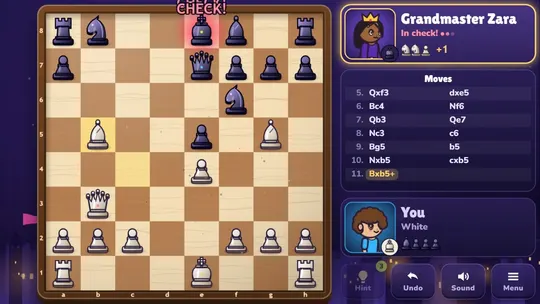
- x means a capture (Bxb5), + means check and # means checkmate.
- O-O is castling on the king's side and O-O-O on the queen's side.
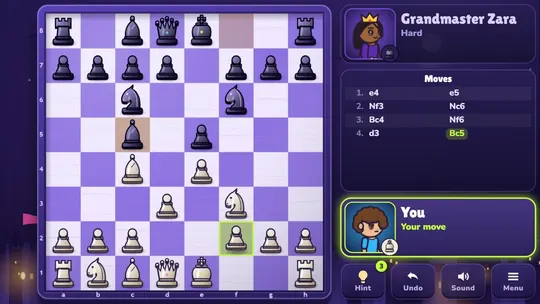
A sample opening, move by move
Here is a calm, classical opening that follows the tips below:
- e4 e5 — both sides claim the centre with a pawn.
- Nf3 Nc6 — White's knight attacks the e5 pawn and Black's knight defends it.
- Bc4 Nf6 — White's bishop aims at f7, the weakest square near Black's king; Black develops and hits e4.
- d3 Bc5 — White calmly defends e4; Black's bishop mirrors White's.
After four moves, both players have pawns in the centre, two pieces developed and a clear path to castle.
10 tips for winning your first games
- Control the centre. Open with a central pawn (e4 or d4). Pieces in the centre reach more squares.
- Develop knights and bishops early. Bring them out before moving the queen.
- Castle in the first ten moves. It tucks your king away and connects your rooks.
- Don't move the same piece twice in the opening unless you must.
- Before every move, ask: what does my opponent threaten? Most beginner games are lost to a simple capture.
- Count attackers and defenders before taking a piece.
- Value your pieces: pawn 1, knight 3, bishop 3, rook 5, queen 9. Trade only when you gain.
- Look for forks. A knight attacking two pieces at once wins material.
- Put rooks on open files — columns with no pawns.
- In the endgame, use your king. With fewer pieces on the board, the king becomes a strong attacker.
Common beginner mistakes
- Bringing the queen out too early. It gets chased around by smaller pieces, and your opponent develops with every attack on it.
- Forgetting about f7 and f2. In the opening, these squares are defended only by the king. Watch for an enemy queen and bishop lining up on them — a common four-move trap.
- Grabbing every pawn on offer. A free pawn is often bait that pulls a piece away from defence.
Practise against friendly opponents
Chess Citadel is our free chess game with full rules — castling, en passant and promotion included. Climb a ladder of four cartoon opponents from Milo (Novice) to Grandmaster Zara (Hard), each with their own personality, or play a friend on the same device. It runs in the browser on any phone, tablet or computer.
Several features make it a gentle place to learn chess for beginners:
- Legal-move highlights. Tap or click a piece and glowing dots show its legal moves, while red rings show captures. You never have to wonder whether a move is allowed.
- Hints and undo. You get three hints per game (H key) and can undo a move (U key). Winning without undo, and winning quickly, earns more stars.
- A live move list in notation, so you can practise reading it as you play.
- The Puzzle Path. Twelve steps teach the classic checkmates, such as king and queen against a lone king. Our guide to chess checkmate patterns explains the same mates.
- A daily checkmate puzzle for a short, focused session.
FAQ
What is the best first move in chess for beginners?
Moving the king's pawn two squares (1.e4) or the queen's pawn two squares (1.d4) is the best start for beginners. Both take space in the centre and open lines for your bishop and queen, so the rest of your pieces can develop quickly.
Can the king capture a piece?
Yes. The king can capture any enemy piece next to it, as long as that piece is not defended. Capturing a defended piece would move the king into check, which is illegal. In the endgame the king becomes a useful attacker, so don't be afraid to use it once most pieces are traded.
What is the difference between checkmate and stalemate?
Checkmate means the king is attacked and has no way to escape, so the attacking side wins. Stalemate means the player to move is not in check but has no legal move at all; the game ends in a draw.
How do I get better at chess quickly?
Play regularly, check your opponent's threats before every move, and review your lost games to find the move that went wrong. Practising against computer opponents of rising strength, like the ladder in Chess Citadel, is an easy way to improve step by step, and learning a few basic checkmates helps you finish won games.
How do I read chess notation like Nf3 or Bxb5+?
Each square has a letter (file a–h) and a number (rank 1–8). A capital letter names the piece — K, Q, R, B or N for knight — and pawns have no letter. So Nf3 is a knight moving to f3. An x means a capture, + means check and # means checkmate.