

Rules
Ludo Rules and Winning Tips: How to Play Ludo Step by Step
How to play Ludo: the board, rolling a 6 to start, moving and capturing tokens, safe squares, the home column and simple strategies that win more games.
By GamesYap Team6 min read
Ludo is a race game for two to four players, and it is one of the first board games many of us ever learned. Each player has four tokens that must travel all the way around the board and into their home triangle. Luck from the dice keeps every game exciting, but the choices you make with each roll decide most matches. This guide explains how to play Ludo step by step, then shows how to make better choices with every roll.
The board
The board is a cross-shaped track of squares around four coloured corners called yards. Each player owns one colour. Tokens start in the yard, travel clockwise around the track and finally turn into their own coloured home column, which leads to the finish in the centre.
Starting: you need a 6
At the beginning all four tokens wait in the yard. To bring a token onto your starting square you must roll a 6. Rolling a 6 also gives you an extra roll, so you can move the new token straight away or bring out another.
Many house rules say that rolling three 6s in a row cancels your turn — a small rule that stops runaway luck.
Moving
On each roll you move one token forward exactly the number shown on the die. If none of your tokens can move (for example, all are in the yard and you did not roll a 6), your turn passes.
You cannot split a roll between two tokens. Choosing which token to move is where strategy comes in.
Capturing
If your token lands exactly on a square occupied by an opponent's single token, that token is captured and sent back to its yard. Its owner must roll a 6 again to bring it out. Capturing is the most powerful move in Ludo, and in many versions it also grants a bonus roll.
Safe squares
Starting squares and the squares marked with a star are safe: tokens standing there cannot be captured. In many versions two tokens of the same colour on one square form a block that opponents cannot pass or capture.
Reaching home
After a full lap your token turns into your home column. Only your own tokens may enter it, so nobody can capture you there. To reach the final home square you usually need the exact number. The first player to bring all four tokens home wins; the others can keep playing for second and third place.
Strategies that work
- Get tokens out early. Use 6s to bring tokens onto the board while it is quiet. More tokens in play means more choices for every roll.
- Don't race a single token. A lone token far ahead gives you nothing to do with bad rolls and is an easy target.
- Stop on safe squares. When a rival is within six squares behind you, a safe square or a block protects your token.
- Count the danger. A token one to six squares in front of an opponent can be captured on their next roll. Move it out of range when you can.
- Capture when it's cheap. Sending home a token that has travelled far costs your rival many turns — usually worth more than moving your own lead token.
Which token should you move? A simple priority list
When a roll gives you several options, run through this list from the top:
- Can you capture? Especially a rival token that has travelled far, or one about to reach its home column.
- Is one of your tokens in danger? If a rival sits one to six squares behind it, move it to a safe square or out of range.
- Can you bring out a new token? On a 6, a fresh token adds options for every later roll.
- Otherwise, advance the token that ends in the safest spot. Avoid landing just in front of a rival.
A worked example
You roll a 4. You have three choices:
- Token A could capture a rival token that is halfway round the board.
- Token B is two squares in front of a rival token, and a 4 would move it onto a star square.
- Token C could move four squares inside your home column.
The capture comes first: it costs your rival a long trip back, and in many rule sets it earns you another roll. With that extra roll, you might move token B to safety too. Token C is already safe in the home column, so it can wait.
Play Ludo online
Ludo Lantern is our free Ludo game for the browser, played on a carved wooden board under festival lanterns. Throw the 3D dice, bring tokens out with a 6 and send rivals home with a capture. Play quick matches against three cartoon rivals on Easy, Normal or Hard, or climb the Lantern Cup rounds — on phone, tablet or computer.
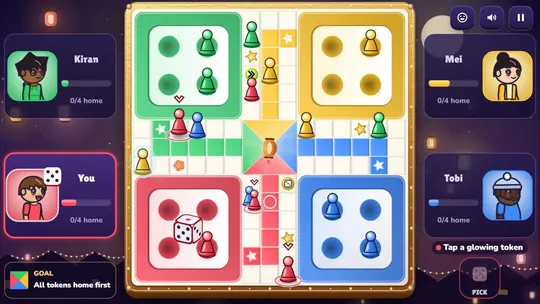
Its rules follow the classic game closely:
- Rolling and moving. Tap Roll or press Space to throw the dice, then tap a glowing token or its glowing target square. Keys 1–4 or the arrows also pick a token.
- Extra rolls. A 6, a capture or bringing a token home gives you another roll, and three 6s in a row end your turn.
- Safe squares. Star squares and start squares are safe, and a token in its home lane must land exactly on the centre.
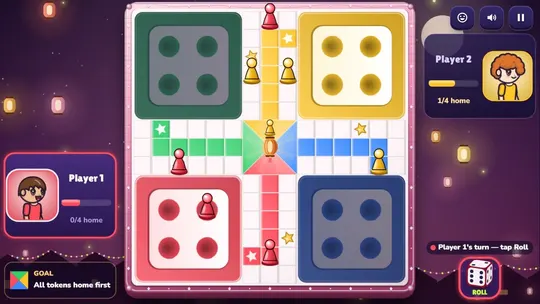
- Quick or Classic. Quick matches give each player two tokens, while Classic uses all four.
- Lantern Powers. This optional rule adds glowing tiles on the track: a Shield that protects a token from capture, a +3 boost and an extra roll.
Against Hard rivals, who prefer safe moves and hunt rival tokens, the priority list above matters most.
Playing with family on one screen? See our list of 2-player games on one device.
FAQ
Do you need a 6 to start in Ludo?
Yes. In classic Ludo a token can only leave its yard when you roll a 6, and the 6 also gives you an extra roll. Some casual variants let a 1 bring a token out as well, but the standard rule is a 6. Agree on house rules before you start, so nobody is surprised halfway through the game.
What are the safe squares in Ludo?
The safe squares are each player's starting square and the squares marked with a star on the track. A token standing on a safe square cannot be captured, which makes them good places to wait while opponents pass by. Count the squares to the nearest rival token behind you.
Do you need an exact roll to finish in Ludo?
In most rules, yes. A token in the home column can only move into the final home square with the exact number. If the roll is too high, that token cannot move and you must use the roll on another token or pass.
How many players can play Ludo?
Ludo is played by two to four players, each with four tokens of one colour. Online versions let you fill the empty seats with computer players, so you can enjoy a full four-player game even when playing alone, or share one device with friends.
What happens if you roll three 6s in a row?
In many versions of Ludo, three 6s in a row cancel or end your turn. The rule stops one lucky player from moving again and again. In Ludo Lantern, a 6, a capture or bringing a token home gives you another roll, but three 6s in a row end your turn.
