

Rules
Snakes and Ladders Rules: How to Play, Variations and Tips
How to play snakes and ladders: setup, turns, ladders and snakes, the exact-finish rule, popular house rules, and tips for playing online with friends.
By GamesYap Team7 min read

Snakes and ladders is one of the simplest board games ever made, and that is exactly why it has lasted so long. You need a board, a die and a token for each player. Nobody has to learn openings or remember tricky moves, so children and grandparents can sit at the same table. This guide explains the snakes and ladders rules step by step, the house rules people argue about, and how the game works when you play it online.
Where the game comes from
The game is very old. Versions of it were played in India for centuries, where the board was a lesson in good and bad deeds: virtues were ladders that lifted you up, vices were snakes that dragged you down. The game travelled to Britain in the nineteenth century and later spread around the world under many names. The idea never changed: a race decided mostly by the dice, with sudden ups and downs along the way. You can read more about old board games in our history of classic board games.
The board
A classic board has 100 numbered squares in a 10 by 10 grid. Square 1 is at the bottom left. The numbers zigzag: the first row runs left to right, the next row right to left, and so on up to square 100 at the top. Ladders connect a lower square to a higher one. Snakes connect a higher square, the head, to a lower one, the tail.
Setup
- Every player chooses a token and places it off the board, just before square 1.
- Decide who starts. A common way is for everyone to roll once; the highest roll goes first.
- Play passes in turn, usually clockwise around the table.
Taking a turn
On your turn you roll one die and move your token forward that many squares, following the zigzag path. Then check where you landed:
- The foot of a ladder: climb straight to the square at the top of the ladder.
- The head of a snake: slide down to the square at its tail.
- Anything else: stay where you are until your next turn.
Only the square you finish on counts. Passing over a snake's head or a ladder's foot does nothing.
Winning: the exact-finish rule
The first player to reach the last square wins. Many families play with the exact-finish rule: you must land on the last square with the exact number. If your roll is too high, you either stay put or, in the more common version, walk to the end and bounce back by the extra squares. The exact finish makes the end of the game tense, because a player one square from home can sit there for several turns waiting for a 1.
Popular house rules
Every family seems to have its own version. These are the most common:
- Roll a 6, roll again. A six gives you a bonus roll. To stop runaway turns, three sixes in a row often cancel the whole turn.
- Start on a 6. Some players need a six before their token can enter the board, as in ludo. (Our ludo rules and tips cover that game.)
- Bumping. If you land on a square another token is on, that token goes back to the start. This adds a little choice-free drama.
- Keep playing. Instead of stopping at the first winner, play on to decide second, third and fourth place.
Agree on the house rules before you start; it saves arguments later.
Is there any skill in snakes and ladders?
Honestly, very little. The classic game has no decisions: the die chooses every move. That is part of its charm. It is a fair game between players of any age, and nobody can blame a bad strategy for losing. The fun comes from the swings: climbing a long ladder past everyone, or sliding down the big snake just before the finish.
Modern versions add small choices and surprises to keep it lively, such as power-ups, traps and different board sizes. When there are choices, a few simple habits help, as you will see below.
Playing snakes and ladders online
Snake Ludu is our free snakes and ladders game for the browser, built on a colourful 3D board. You can play a quick match with real players, open a private room for up to 10 friends with an invite link, or practise against bots. The dice are rolled on the game's server, so every roll is fair, and it works on phones, tablets and computers.
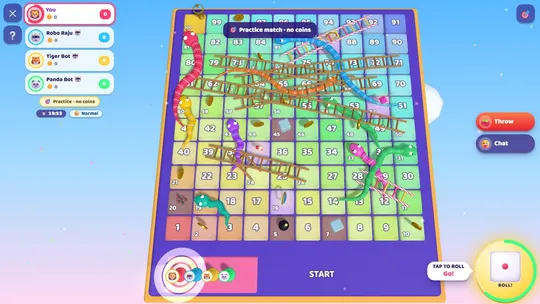
Snake Ludu keeps the classic rules — ladders up, snakes down, a six rolls again, three sixes lose the turn and the last square needs the exact number — and adds a few twists:
- Board sizes from a quick 50-square Mini to a 300-square Legend.
- Coins on the board add to your score, and bombs take some away.
- Ice freezes you for your next turn and spike pits push you back.
- Power-ups: a shield blocks your next snake bite, a pink gem gives an extra roll and a rocket flies you forward.
- Fun between turns: throw tomatoes, eggs or slippers at the other players and send emoji or quick chats.
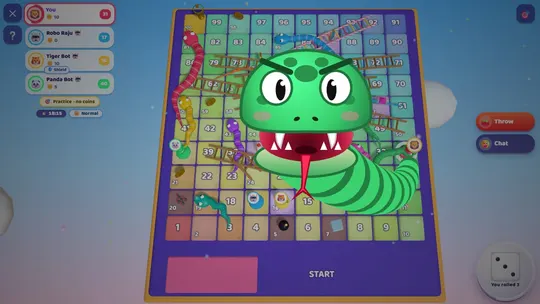
Tips for playing online with friends
- Start small. A 50-square board takes a few minutes and is perfect for learning the traps. Move up to 100 or more when everyone knows the board.
- Use private rooms for family games. Share the invite link in your family chat. Everyone opens it on their own phone and joins; turn auto-accept off if you want to let people in one by one.
- Pick the right number of seats. Bigger rooms are louder and funnier; with more than four players the match ends once the first few have finished, so nobody waits forever.
- Save your shield for the top of the board. A snake near square 100 costs far more than one near the bottom, so a shield matters most late in the game.
- Count before the finish. Near the end, check exactly how many squares are left. Only that number gets you home, and anything higher bounces you back.
- Keep it friendly. Throws and quick chats are part of the fun. A rose or a trophy after a good game goes a long way.
If you enjoy dice races, try Ludo Lantern next: it adds real choices about which token to move. For more games to play together, see our list of free board and card games or browse all board games.
FAQ
How many players can play snakes and ladders?
On a table, two to four players is usual, though nothing stops more from joining if you have enough tokens. Online, Snake Ludu's Quick Match seats 2 to 4 players, and a private room takes up to 10 friends, with bots filling any empty seats if you like.
Do you need a 6 to start in snakes and ladders?
Not in the classic rules: every player starts off the board and moves on their first roll. Needing a 6 to start is a house rule borrowed from ludo. Agree on it before the game, because it makes the opening slower and adds more waiting.
What happens if you roll too high at the end?
With the exact-finish rule you must land on the last square exactly. Some families make you stay where you are if the roll is too high; most move to the end and bounce back by the extra squares. Snake Ludu uses the bounce-back version.
Is snakes and ladders just luck?
The classic game is pure luck: the die decides every move and there are no choices. That is why it is fair for all ages. Modern versions such as Snake Ludu add power-ups, traps and board sizes, but the dice still decide most of the race.
Can I play snakes and ladders online with friends for free?
Yes. In Snake Ludu, open a Private Room, choose the board and number of seats, and share the invite link. Friends open it in their browser and join the room, or ask first if you turn auto-accept off. It is free and needs no download.
