Tips
Blade IO Game Tips: Blade Tiers, Clashes and When to Fight or Dash
Blade io game tips for Orbit Breaker: how the six blade tiers work, what happens when orbits clash, reading the power number and when to fight or dash.
 By Mahedi Hasan7 min read
A blade io game looks simple: your blades spin around you, you walk, and whoever has more blades wins. Play a few rounds and you find out that is only half true. Which blades you carry matters more than how many, where you walk decides what you can collect, and knowing when to back away keeps you alive long enough to grow. These blade io game tips use Orbit Breaker, our free online blade arena, as the example, with the real numbers from the game.
How the arena works
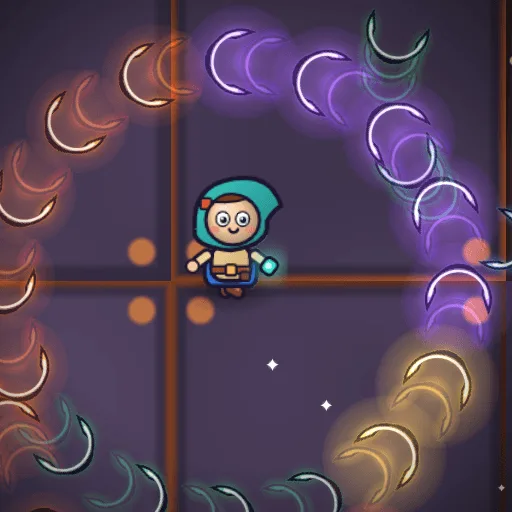
You join one shared arena with other players and computer-controlled heroes, so it is never empty. You start with three Tin blades and a three-second shield that keeps you safe while you find your feet. Your blades orbit you on their own; you only steer. Walk over a loose blade, or let your orbit sweep across it, and it joins your ring. You can carry up to 24.
When two orbits meet, the blades clash. A blade that reaches another hero's body hurts it, and a hero at zero health is knocked out and drops every blade it carried on the floor. That is the whole loop: collect, clash, knock out, collect what falls.
Learn the six blade tiers
Every blade has a tier, and the tier decides almost everything. In a clash, each blade loses durability equal to the other blade's strength. A strong blade has more durability and hits harder, so it cuts through weak ones while barely losing anything.
| Tier | Durability | Clash strength | Body hit |
|---|---|---|---|
| Tin (gray) | 3 | 1 | 7 |
| Steel (blue) | 5 | 2 | 9 |
| Jade (green) | 8 | 3 | 11 |
| Ember (orange) | 12 | 5 | 14 |
| Storm (violet) | 17 | 7 | 17 |
| Sun (gold) | 24 | 10 | 21 |
Read the table the way a fight plays out. A Tin blade that meets a Storm blade breaks at once, and the Storm blade loses only 1 of its 17 points. Two Tin blades wear each other down over three touches. So twelve Tin blades do not beat six Ember blades: the Ember ring cuts through them one after another.
Your power, the number next to your name, is the sum of your blades' clash strength. Twenty-four Sun blades would make 240, the most anyone can reach.
Grow from the edge inward
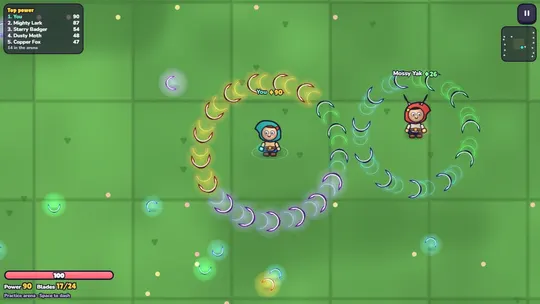
Where a blade lies tells you how good it is. The outer ring of the arena is mostly Tin and Steel. The middle ring adds Jade and the odd Ember. Near the center you find Jade, Ember, Storm and, now and then, a Sun blade. The center is also where the strongest heroes gather, because they want those blades too.
- Start at the edge. New heroes appear away from the middle. Fill your orbit with Tin and Steel first; there are plenty and few heroes fight over them.
- Sweep, don't step. Your orbit collects blades as it passes over them, so you can gather a cluster without walking onto every blade.
- Trade up when you are full. With 24 blades, a better blade replaces your weakest one. A blade of the same tier or lower mends your most worn blade instead, so nothing is wasted.
- Head inward once you are strong. When your orbit is full of Jade and better, the center's Ember and Storm blades are worth the risk.
A bigger orbit also slows you down a little, so a hero with 24 blades is easier to escape than one with eight.
Read the power number before every fight
Every name in the arena shows a power number, and its color tells you what to do. Red means that hero is clearly stronger than you. Green means clearly weaker. White means you are about even.
- Chase green, avoid red. Fighting a red name usually costs you blades for nothing.
- Count what you see. Worn blades look darker. A hero with many dark blades is weaker than its number suggests, because those blades are close to breaking.
- Even fights are coin flips. If two white names meet, the one with higher tiers usually wins, not the one with more blades.
- Watch the board. The leaderboard and the map show where the strongest heroes are. Gold on the map marks the leader, so you know which corner to leave alone.
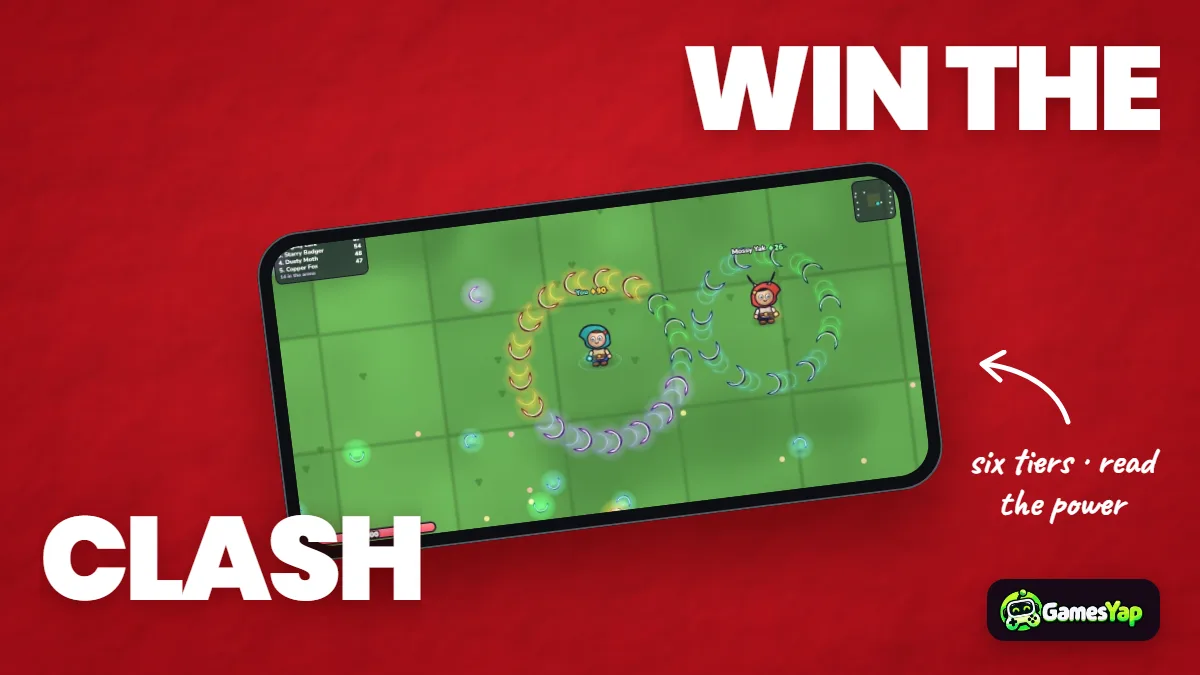
Win the clash
A clash is decided by tiers, but how you approach still matters.
- Bring your orbit, not your body. Your blades sit on a ring around you. Line that ring up with the enemy so it is your blades that touch theirs first.
- Strike a hero whose ring is broken. When a rival's blades are gone, your blades reach its body. Each hit costs it health, and a clearly stronger hero even hurts a weaker one by bumping into it.
- Mind the knockback. Every clash pushes both heroes apart a little, and a body hit knocks the victim back. Step back in after each bump to keep the pressure on.
- Heal between fights. Health starts to come back after three seconds without a hit. A knockout also heals you a good chunk, so finishing a fight is often safer than running from it.
Use the dash at the right moment
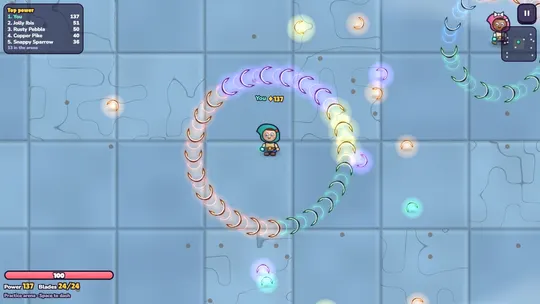
The dash is a short burst of speed with a cooldown of a few seconds. On a phone it is the round button; on a computer it is Space. The button turns gray while it recharges.
- Escape first. The most useful dash is the one that gets you out of a red name's reach before its orbit closes on you.
- Close the gap second. Dashing toward a fleeing green name brings your orbit onto it before it reaches the wall.
- Grab the drop. After a knockout, every blade the loser carried lies on the floor. A dash gets you there before other heroes arrive.
Play well on a phone
Orbit Breaker is built for one thumb. Drag anywhere and a stick appears under your finger, so you never have to find a fixed control. Keep your other thumb near the dash button, and hold the phone upright for a taller view or sideways for a wider one. As your orbit grows, the camera pulls back so you can still see what is coming.
When you get knocked out
It happens to everyone. Play again for free and you start fresh with three Tin blades at the edge. Once per visit you can also watch an optional short video to come back with the better half of the blades you had, which is a quick way back into the middle. It is help only; videos never give points.
Want a different kind of arena? Our guide to playing a snake .io game online covers Serpent Arena 3D, and Orbit Breaker's Survivor mode has its own survivor game tips. More games like these are in the .io games category.
FAQ
What is a blade io game?
A blade io game is an online arena game where your weapons are blades that orbit around your hero. You collect more blades to grow, and when orbits meet, the blades clash and the weaker ones break. Knocked-out heroes drop their blades for everyone else, so the arena keeps changing as players grow and fall.
Which blade tier is the strongest in Orbit Breaker?
Sun is the strongest tier, with 24 durability, a clash strength of 10 and the hardest body hit. Sun blades are rare and lie near the center of the arena. Storm, Ember, Jade, Steel and Tin follow in that order, so a few high-tier blades often beat a ring full of Tin.
Are the other heroes real players?
Some are. You join one shared online arena, and computer-controlled heroes fill the empty places so there is always something to fight. Everyone plays by the same rules on the game server, and the leaderboard lists every hero in your arena with its power.
How do I stop losing my blades so fast?
Avoid red names, and make sure your blades are better before you fight, not just more numerous. Collect from the edge until your orbit is full, then trade up toward Jade and Ember. Use the dash to leave a fight you are losing before your ring breaks.
Is Orbit Breaker free to play on a phone?
Yes. Orbit Breaker is free in the browser on phones, tablets and computers, with nothing to download. You play with one thumb, the round button dashes, and the game runs in portrait or landscape.