

Tips
Idle Farm Game Tips: Ripe Fields, Full Stalls, No Crows
Idle farm game tips for Gram Bangla Farm: carry the harvest to the haat stalls, hire farmhands, shoo the crows and follow the market days.
By GamesYap Team7 min read
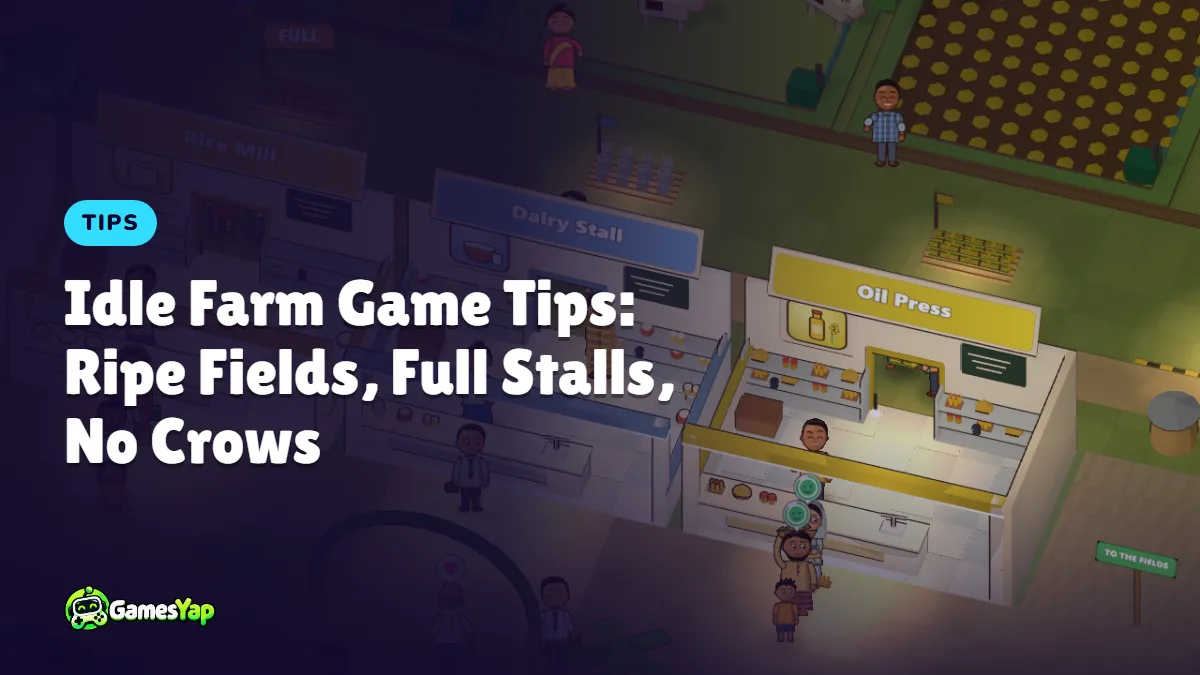
There is something calming about a field that grows while you work. Green shoots turn tall and golden, the cut sheaves pile up, and a line of buyers waits at a stall for the rice you just brought in. These idle farm game tips are built around Gram Bangla Farm, our free 3D village farm, where you walk the farm yourself and carry every harvest from the fields to the stalls of the village haat.
You play Joba. Her grandmother, Nani, has handed her a single paddy field and a rusty sickle, and Joba wants to turn it into the biggest farm around. Tutul, a boy who keeps the harvest board by the farm office, cheers her on, and later Fazlu Chacha, the old scarecrow keeper, helps against the crows.
Learn the loop first
Every line on the farm has two halves. At the back is its field, shed or orchard. In the paddy field you can see the crop grow taller and turn from green to gold. When it is ready, the field worker cuts it, and the harvest lands on a bamboo mat in the farmyard: sheaves of paddy, cans of milk from the cow shed, bundles of mustard.
Stand at the mat and the harvest jumps into your hands. Walk round to the back door of the line's stall and it goes onto the racks. The seller at the front, Rahim at the Rice Mill or Bokul at the Dairy Stall, sells the produce to the buyers in line, and every coin goes straight to you.
That is the whole game in one sentence: harvest from the mat to the stall, before the line runs out of patience.
Keep every stall stocked
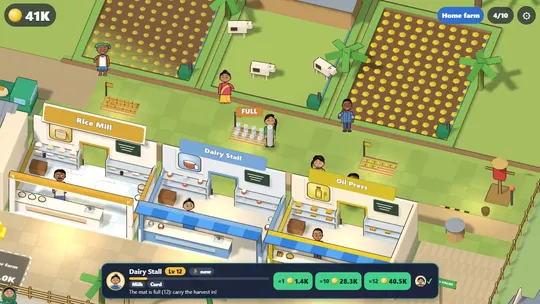
The most common way to lose coins is an empty stall. When its racks run out, the buyers at the front wait, a little bubble with the produce they want appears over their heads, and their faces slowly turn from green to red. If they wait too long, they walk out without paying.
So keep an eye on all three stalls, not just the one you are standing at. Fill your hands at whichever mat is fullest and drop the harvest where the line is longest. The yellow guide arrow helps: it points at the stall that needs you most.
A full mat is a warning too. When a mat is full, the next harvest has to wait in the field, and a FULL sign blinks over it. Your hands hold six items at the start and two more with every line you open, so later trips carry much bigger stacks.
Read the fields
The fields are more than scenery: they are the clock. A short green crop means the next harvest is far away; a tall, golden one means it is nearly ready. The cow shed, the hen house and the bee boxes have no crop to watch, but the harvest board by the farm office shows every line's next harvest in seconds.
Use this to plan your walk. If the paddy is golden and the mustard is still green, wait near the Rice Mill's mat, and fill the Oil Press later.
Grow the stalls
Stand at a stall to see its card. It shows the level, the kinds of produce on sale, the next harvest and what the next new look brings. You can buy one level, ten levels or as many as your coins allow, or press E on a keyboard.
New looks come at levels 10, 25 and 50. The bamboo stall with its striped awning becomes a painted stall, then a tiled one, then a dark wood stall lit with bulbs. The field behind grows with it: a pump and a water channel, then a shed, then brick edges. Each new look brings a bigger harvest and one more kind of produce, so the Rice Mill adds puffed rice, flattened rice and rice pitha, and the Dairy Stall adds curd, ghee and sandesh. Newer kinds sell for more.
Levels 10, 25, 50, 75 and 100 also double the line's pay, so a line just below a milestone is often the best thing to buy.
Hire farmhands early
Every stall's card has a button to hire a farmhand. A farmhand carries the harvest from that line's mat to its stall all day, and from level 25 a line can take a second one.
Farmhands free you for the stall that needs you most. They also keep the farm selling while you are away: a line with a farmhand keeps earning for up to eight hours. Hire one for every line before you spend big on levels.
Shoo the crows
After about seven minutes of play, the first crows land. Seven of them hop about the farmyard, the scarecrow post's lamp blinks red, and no harvest comes in at that farm until every crow is gone.
Walk straight at each crow and it flies off with a flap. The guide arrow leads you to the nearest one. Crows never take your harvest or your coins; they only hold up the next harvest, and they leave on their own after a little over a minute.
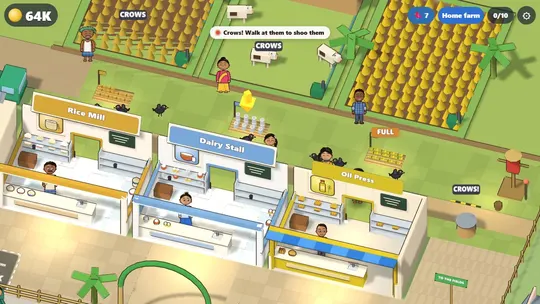
Once you can afford him, hire Fazlu Chacha at the scarecrow post. From then on he drives the van to whichever farm has crows and shoos them himself, so they no longer pull you away from the lines.
Follow the market days
Now and then a market day pushes one stall, or every stall, for a few minutes. Harvest time fills the Rice Mill, winter mornings fill the Dairy Stall, mango season fills the Mango Stall, and a big haat day lifts everything at once.
When a market day starts, stock that stall first and keep it full while it lasts. The note at the top of the screen tells you which one is coming a minute before it starts.
Buy the farm's extras
On the verge left of the gate, each farm has its extras: a tube well, scarecrows and a solar pump, then a power tiller and a haat banner over the gate. Every extra adds to every sale at that farm, so they are worth buying once the stalls are running well.
Open the next farms
When the three lines at the home farm are open, a dashed zone appears at the end of the haat ground. It opens the char farm on new river land, with jute, a vegetable garden and a hen house. Later the orchard farm brings mangoes, sugarcane for gur and bee boxes for honey. Each farm has its own road, its own buyers and its own crows.
Drive the farm van between farms: stand at the spot next to it in the farmyard and tap a farm. When all three farms run well, save up for the Nabanna festival, the harvest festival where every sale at every farm is doubled.
Little habits that add up
- Fill your hands before you walk. A full stack saves a trip.
- Watch the crops: golden means a harvest is close.
- Shoo the crows the moment they land.
- Stock the market day's stall first.
- Zoom out with a pinch, the mouse wheel or the minus key to see the whole farm.
If you enjoy this kind of game, try Machh Chash with our idle fish farm tips, or Mela Maath with our idle fair tycoon tips. You can find more in the idle games and simulation games categories, and signed-in players can read how GamesYap points work.
FAQ
Is Gram Bangla Farm free to play?
Yes. Gram Bangla Farm is free to play in your web browser on phones, tablets and computers, with nothing to download or buy. Every line, level, farmhand and farm is paid with coins you earn in the game. Signed-in players also earn GamesYap points for every new line they open and for five achievements along the way.
Do the crows come at random?
No. Crows follow a fixed clock as you play, at your farms in turn, and each visit ends on its own after a little over a minute. They never take your harvest or your coins. They only stop new harvests coming in until you shoo them, and Fazlu Chacha can do that for you.
Why are my buyers leaving without paying?
A buyer leaves when they wait too long at an empty stall. A stall can only sell what is on its racks, so bring the harvest from the mat behind it, or hire a farmhand so its racks never run dry. A bubble over someone's head shows which produce they are waiting for.
What should I buy first?
Open the Dairy Stall as soon as you can, then hire a farmhand for each line and level the stall with the longest line. Buy the tube well once it is cheap, and save for Fazlu Chacha before your first trip to the char farm, so the crows there do not pull you away from the busy stalls.
