

Tips
Idle Boat Tycoon Tips: Routes, Pontoons and Storm Signals
Idle boat tycoon tips for Launch Ghat: which routes and launches to buy, how the pontoon limits the crowd, how to read storm signals and when to move.
By GamesYap Team6 min read
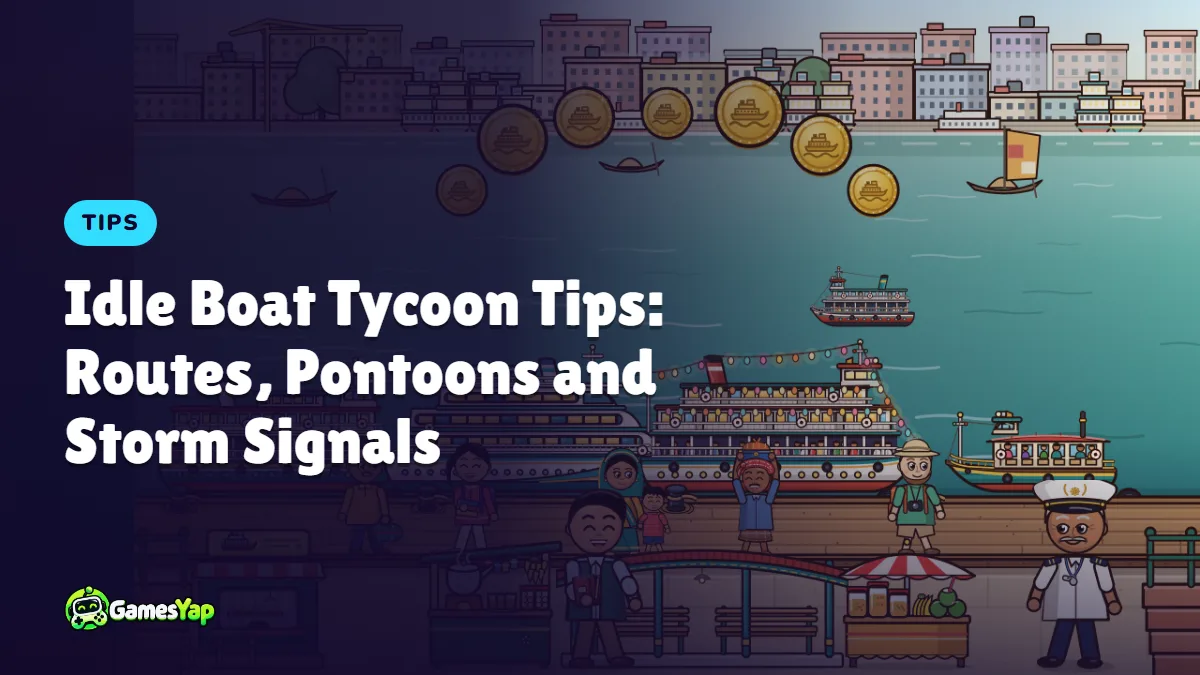
A river ghat is never quiet. Launches blow their horns, porters shout, tea glasses clink and a crowd waits on the pontoon for the next departure. These idle boat tycoon tips are built around Launch Ghat, our free river port game, where one small launch at an old ghat grows into a fleet of river cruisers. Many of the ideas also work in other idle and management games.
In Launch Ghat you play Rafi, who has just taken the lease of an old ghat. Sareng Chacha, a launch captain with forty years on the river, teaches him the ropes. Mitu runs the ticket counter, and Lal Mia, the leader of the porters, always knows when the pontoon is too crowded.
How the ghat makes money
Three things decide your income, and every tip below fits into one of them.
- Launches on routes. Every launch earns fares and brings passengers. A bigger launch type earns twice as much and brings twice as many people.
- The pontoon. Every passenger has to cross it. It can only carry so many people a second, so the berths and gangways decide how many actually board.
- The weather and your reputation. Fog, storms and rush days change the day's takings, and good storm calls raise your fares for good.
At the start there is only one launch to buy, so you tap the ghat to help the first passengers on board. Ten coins buy the first launch to the Char Island, and the horns start blowing.
Open routes in order
There are eight routes, and each one opens after the one before: Char Island, Market Town, Rice Fields, Mangrove Coast, Guava Orchards, River Harbour, the Delta Line and the Hill River. The first launch on a new route is always the big jump, so a simple rule works well:
- Open the next route as soon as you can afford it.
- In between, add launches to your newest route, not the oldest one.
- Upgrade the launch type when a route reaches 10, 25, 50 and 100 launches.
The launch types go from a small wooden launch to a double-decker, a big double-decker, a night launch with strings of lights, and finally a white river cruiser. Each step doubles that route's fares, but it also doubles its passengers, which brings us to the pontoon.
Keep the served share high
The strip under the ghat shows the served share: the part of your passengers who actually get on board. Anyone who cannot cross the pontoon in time misses the launch and pays nothing, so a low served share wastes a big part of your income.
You will see it on the river too. When every berth is busy, arriving launches wait in the middle of the river, and boarding takes longer when the pontoon is crowded.
- Berths add a whole extra lane, up to four. They are expensive, but each one adds as much space as one of your existing berths.
- Gangways make every berth carry more people. They are the steady upgrade between berths.
- The rule of thumb: when the served share drops below about 80%, the next coins go into the pontoon, not into more launches.
Read the storm signal
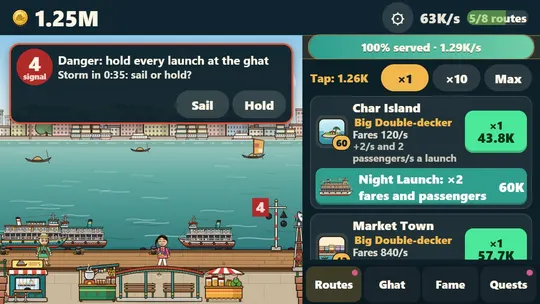
Storms are the heart of the game. A minute before each storm, a signal mast goes up at the end of the pontoon with a number from 1 to 4, and a card asks you to choose Sail or Hold.
- Signal 1 or 2: the water is rough, but the launches can sail. Choose Sail and every ticket pays storm fares, half as much again as usual.
- Signal 3 or 4: it is dangerous. Choose Hold, and the passengers wait at the ghat. You still earn part of the fares, and more with a waiting shed.
- If you sail on a high signal, the launches turn back. Everyone is safe, but the fares are paid back and your reputation drops.
Every right call raises your reputation, which raises all your fares, up to 130%. If you miss the card, Sareng Chacha holds the launches for you. That is safe, but it does not count as a call, so it is worth keeping an eye on the river.
Plan for fog and rush days
Fog rolls in now and then and slows the launches to half speed. A radar gets them moving again, and each level helps a little more. Buy the first level once your income is steady, because fog comes back again and again.
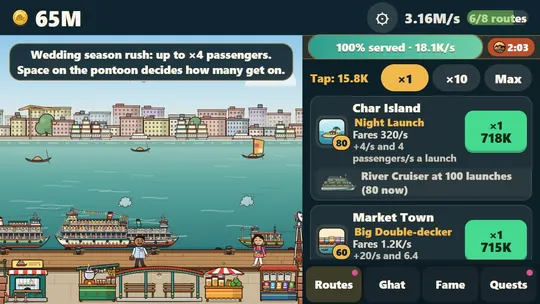
Rush days are the opposite: four times as many travellers come to the ghat for a few minutes. That is a lot of extra fares, but only if the pontoon can carry them. The waiting shed adds space on rush days, so a few shed levels turn a rush from a crowded mess into your best few minutes.
Use the ghat shops
The tea stall opens with your second route, the snack stall with your fourth and the book stall with your sixth. Each level adds a share of all your fares, including the smaller takings while the launches are held in a storm. Buy a few levels when they are cheap compared to your next launch.
Take over a new ghat
Once all eight routes are running, the Fame tab lets you take over a ghat in a new town. Your launches, pontoon, shops and coins start again, but you keep your Ghat Fame and your reputation. Each fame point adds 2% to all your fares and taps for good. The first move takes you to a ghat with palm trees on both banks, and the next to the wide water where the big rivers meet.
A good time to move is when the next upgrade would take longer than replaying the early game with your new fame.
If you enjoy games like this, also try Brick Field with our idle factory tycoon tips, Cloud Garage with our idle server tycoon tips, or Market Tower with our idle mall tycoon tips. You can find more in the idle games and simulation games categories, and signed-in players can read how GamesYap points work.
FAQ
Is Launch Ghat free to play?
Yes. Launch Ghat is free in your web browser on phones, tablets and computers, with nothing to download or buy. Optional ads can clear the fog or give a short ticket boost, but they never give points.
Can a launch sink in a storm?
No. Nothing in the game is ever in danger. If you sail on a high signal, the launches simply turn back to the ghat and the fares are paid back.
Are the storms random?
No. Storms, fog and rush days come on a fixed schedule as you play, and each storm's signal is shown a minute ahead. Good play is about reading the signal, not luck.
What should I buy first?
Buy the first launch with your first ten coins, then open each new route as soon as you can. Add a berth or wider gangways whenever the served share drops below about 80%.
