Guides
Match 3 Strategy: Special Gems, Cascades and Beating Levels in Fewer Moves
Match 3 strategy that works in any game: build line and burst gems, start cascades from the bottom, spend moves wisely and focus on the level goal.
By GamesYap Team7 min read
Most match 3 levels are not lost on the last move; they are lost on the first ten, when easy matches are taken without a plan. A solid match 3 strategy turns the same board into big special-gem combos and long cascades that do the work for you. This guide covers the habits that matter in every swap-to-match puzzle, then shows how to use them in Gem Cascade.
The basics in one minute
You swap two neighbouring pieces so that three or more of the same kind line up in a row or column. They clear, the pieces above fall down, and new ones drop in from the top. If those falling pieces form new matches, they clear too: that chain is a cascade.
Levels usually give you a goal (collect certain pieces, reach a score, clear blockers) and a move limit. So the real question is never "Can I make a match?" but "Which match gets me closest to the goal?"
Make special gems before easy matches
Matching more than three pieces usually creates a special piece. The exact rules differ between games, but the common pattern looks like this:
| Match shape | Typical result | Best use |
|---|---|---|
| 3 in a line | Plain clear | Setting up bigger matches |
| 4 in a line | Line clearer (row or column) | Long rows full of goal pieces |
| L or T shape | Area blast | Crowded corners and clusters |
| 5 in a line | Strongest special | Saved for when it matters most |
Before you take an obvious three, scan the board for a four, an L or a T. Spending one move to make a special piece is almost always better than spending it on a plain match, because the special clears many pieces later.
How to spot hidden fours and L shapes
- Look for two pairs of the same colour with one gap between them; a single piece sliding into the gap makes four.
- Look for a pair in a row that meets a pair in a column at a corner: that is an L or T waiting to happen.
- Check the piece you are moving too. A swap creates matches at both ends, so one move can form two lines.
Work from the bottom of the board
Where you match is almost as important as what you match.
- Matches low on the board shift everything above them. More pieces fall, so there are more chances for cascades.
- Matches near the top only refill the top rows, which rarely triggers anything extra.
- Cascades are free moves. Every extra clear from falling pieces costs you nothing, so starting them near the bottom is real profit.
There is one exception: if a goal piece or a special gem sits near the top and you can grab it now, take it. A sure goal beats a hopeful cascade.
Move economy: think like a budget
Moves are the currency of every match 3 level. Treat them that way.
- Count what you need. If the goal asks for 15 green gems and you have 14 moves, every move must collect at least one green on average.
- Prefer matches that help the goal or set up a special. Off-goal matches only earn their place if they create a special gem or open the board.
- Don't panic-match. When the board looks bad, the urge is to take any match. Spend a few seconds looking for a four first.
- Save specials for crowded spots. A line clearer fired across a row full of goal pieces is worth several normal moves.
Combine special gems
In many match 3 games, swapping two special pieces into each other fires both at once. A line clearer plus an area blast, or two line clearers crossing, can clear a huge part of the board in one move. When two specials are next to each other, check whether combining them helps the goal before using them one by one.
Applying this match 3 strategy in Gem Cascade
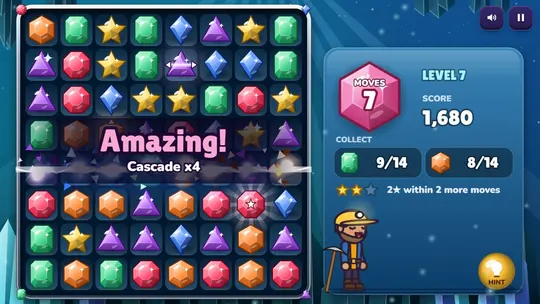
Gem Cascade has 24 levels across six mines, from the Copper Tunnels down to the Sky Geode, and every level has a collect goal and a move limit. Here is how its real rules line up with the tips above.
- Swapping. Swipe or drag a gem onto a neighbour, or tap two neighbouring gems. On a keyboard, arrows move the cursor, Space or Enter picks a gem and an arrow swaps it.
- Line Gem. Match four in a row. When it is matched later, it clears its whole row (from a horizontal match) or column (from a vertical match).
- Burst Gem. Match five in a row, or an L or T shape. It clears the 3×3 area around it.
- Combos. Swap two special gems together to fire both at once.
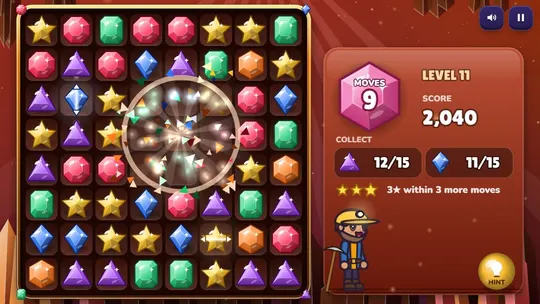
- Goals. The panel shows the gems to collect. From level 5 you usually collect two kinds, and every fourth level is a "big dig" with three kinds. Gems cleared by cascades and blasts count towards the goal too.
- Safe swaps. A swap that makes no match simply slides back, and if no moves are left on the board, it shuffles itself.
Stars and spare moves
Finishing a level earns one star. You earn two or three stars by finishing within the move limits shown on the goal card, and unused moves turn into bonus score. That makes move economy the whole game: a Line Gem fired along a row of goal gems can save you three or four moves at once.
When you are stuck
Tap HINT or press H to see a good move; a hint also appears by itself after a few idle seconds. Digby the miner, who stands beside the board, shows what is still to collect and warns you when moves run low.
If you like this kind of planning, our bubble shooter tips use the same look-ahead thinking in Bubble Reef, and the 8x8 block puzzle strategy is great practice for spotting space on a grid. You can find more in our match 3 games.
FAQ
What is the best match 3 strategy for beginners?
The best match 3 strategy for beginners is to look for special-gem matches before taking easy threes, and to make matches near the bottom of the board, where falling pieces start more cascades. Always keep the level goal in mind: a match that collects the pieces you need is worth more than a bigger match of the wrong colour.
Why should you match at the bottom in match 3 games?
Matching at the bottom moves every piece above it. More pieces fall into new positions, so there is a better chance that they line up into extra matches by themselves. These cascades clear pieces without using a move. Matches near the top only refill the top rows and rarely trigger a chain.
How do you make special gems in match 3?
In most match 3 games you make special gems by matching more than three pieces. Four in a straight line usually makes a line clearer for a row or column, while an L or T shape, or five in a line, makes a stronger piece that blasts an area. Look for two pairs with one gap between them to find these chances.
What happens when you run out of moves?
When you run out of moves before reaching the goal, the level is lost and you play it again. In Gem Cascade you can take a free retry that continues the level with five extra moves, or restart the level at any time for free. Planning moves from the start is the best way to avoid running short.
How many levels are in Gem Cascade?
Gem Cascade has 24 levels spread across six mines: Copper Tunnels, Silver Seams, Crystal Caverns, Lava Depths, Starlight Vault and Sky Geode. Each level asks you to collect certain gems within a move limit, and you can win up to three stars by finishing with moves to spare. There is also a daily dig, the same board for every player that day.