

Tips
Idle Dev Tycoon Tips: Better Reviews, Fewer Bugs, a Bigger Studio
Idle dev tycoon tips for App Studio: how to plan apps users love, win the bug hunt, chase the hot genre, grow the team and when to start a new studio.
By GamesYap Team7 min read
Making apps sounds like a dream job for an idle game: you plan something clever, the team builds it, and money rolls in while you sip your tea. The catch is that users are picky. These idle dev tycoon tips are built around App Studio, our free app studio game, where a young freelance developer grows a studio from one laptop to a whole floor. Many of the ideas also help in other management games.
In App Studio you play Tuhin. It is 2010, he works from his bedroom in Dhaka, and his last client never paid. Rumki Apu, who once ran her own startup, becomes his mentor. Nadia is the first person he hires, and Rakib later tells the world about the apps. The calendar runs from 2010 to 2030, one month for every minute you play, and new platforms, genres and people arrive with the years.
Plan every app on purpose
Each app starts on the Build tab with four choices: a genre, a platform, a size and a few feature cards. It is tempting to tap through quickly, but this screen decides almost everything about the review score.
The genre sets what users expect and how much each user pays. Puzzle apps are where everyone starts, and later genres such as racing games, money apps and AI helpers pay much more per user. The platform sets how many people you can reach. Phones arrive in 2012 and reach about three times as many people as the web, tablets come in 2015 and pay more per user, and smart glasses appear in 2024.
Not every genre suits every platform, though. Once you have released a genre on a platform, the planner shows fit dots for that pair. Three dots means a great fit. One dot means users on that platform do not really want that kind of app, and the review will say so.
Learn what users want from the reviews
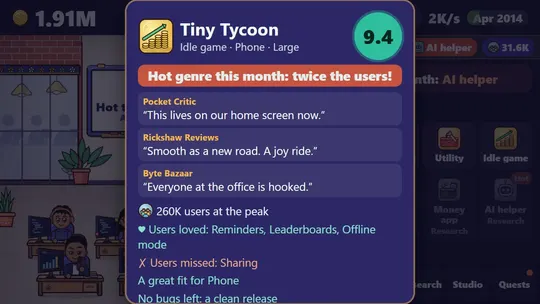
The most important part of every review is the short list at the bottom. It tells you which of your features the users loved and reveals one feature they missed. From then on, a heart appears on that feature card whenever you plan an app of the same genre.
This is the real skill of the game. Every genre has a few features its users ask for: puzzle players like leaderboards and sharing, for example, while education users care about offline mode. Each review teaches you a little more, and what you learn is never lost, not even when you start a new studio. A good habit is to plan the next app of a genre with every heart you know, then fill the last slot with something new to test.
You start with two feature slots. Research adds a third early on and a fourth later, so keep an eye on those upgrades on the Research tab.
Win the bug hunt
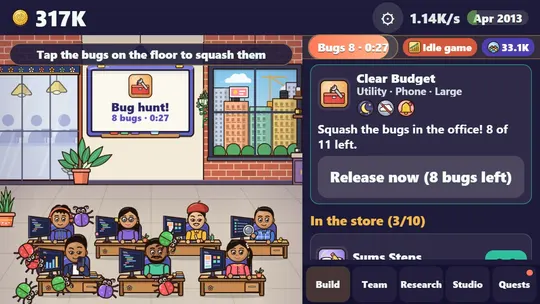
When the team finishes coding, the testers report the bugs they found, and the bug hunt starts when you are ready. Little cartoon bugs crawl over the office floor, and you tap them to squash them before the timer runs out. Every bug that survives costs a few tenths of a point on the review.
A few tips make the hunt much easier:
- Tap the bugs near the edges first. They change direction often, but the ones by the walls have less room to run.
- Do not chase one bug across the whole room. Tap whichever bug is nearest to your finger.
- On a computer, Space squashes the bug nearest the middle of the floor.
- Hire testers. They find bugs before the hunt, so fewer bugs crawl out at all.
If you are short on time, you can always release at once. The team then fixes about half of the bugs on its own. That is a fair choice for a small app, but a big app with many bugs is worth the thirty seconds of squashing.
Match the size to the team
Small apps are quick and safe. Medium, large and mega apps reach many more users, but each size needs a team with enough total skill. The size buttons tell you when the team is too small. Ignore that warning and the review loses points, and the designers' polish counts for less as well.
The best moment to move up a size is right after a few hires or a round of training. Mega apps need research first and a big, well-trained team. Rumki Apu warns you about this in the story, and she is right.
Chase the hot genre
Every month one genre is hot, and the strip at the top always shows which one. An app of the hot genre reaches twice as many users at its peak, which is often worth more than a perfect feature list. The trend moves through all eight genres in a fixed order, so you can plan ahead, and a rewarded ad can show you the next six hot genres if you like.
The hot genre counts from the moment you start building, so check the strip before you press Start. If this month's genre is one you have not researched yet, build your best known app and wait for the next one.
Grow the team in the right order
Developers code fastest, but everyone in the team codes a little. Designers add polish to every app, testers cut the number of bugs before the hunt, and marketers bring more users to every release. A balanced team scores better than four developers alone.
New people send their CVs in their own years, from Nadia in 2010 to the last hire in 2022. You need a free desk for each one. The bedroom has three desks, the shared office opens in 2011 with seven, and the studio's own floor opens in 2015 with thirteen. When every desk is taken, the next move is the office.
Training is the quiet workhorse. Each level adds half of a person's starting skill, so training your best developer is often better value than waiting for the next CV. Spend spare coins there between bigger buys.
Keep the store full
A new app peaks at release, and then most users drift away, but a loyal core stays for good. The store shows your newest ten apps, and their loyal users keep paying while you are away. That is why steady releases matter more than one giant hit: every app you ship adds to the income that is still there when you come back.
While you are away, the team also finishes the app it was building. The bug hunt waits for you, so your first job on return is usually a quick hunt and a fresh plan.
Start a new studio at the right time
From 2020 the Studio tab offers a new studio. You go back to 2010 with one laptop, and the coins, team, research and apps start again. In return you keep Legacy, which grows with everything you have ever earned and brings more users to every app. You also keep every heart and fit dot, and the months pass faster in each new studio.
The first new studio is worth it as soon as the gain is a good few dozen Legacy. Later on, wait until the gain is at least half of what you already have. You can also play on to 2030 for the full story first: the calendar stops there, and a new studio is ready whenever you are.
If you enjoy games like this, also try Mela Maath with our idle fair tycoon tips, Cloud Garage with our idle server tycoon tips, or Machh Chash with our idle fish farm tips. You can find more in the idle games and simulation games categories, and signed-in players can read how GamesYap points work.
FAQ
Is App Studio free?
Yes. App Studio is free to play in your web browser, with nothing to download, install or buy. Every genre, platform, team member and research idea is free, and coins exist only inside the game. Signed-in players also earn GamesYap points for each new year on the timeline and for three achievements.
What gives the best review score?
Five things: the features that genre's users want, a platform that suits the genre, a team big enough for the size, the designers' polish and as few bugs as possible. The review lists what users loved and reveals one feature they missed, and the hearts on the feature cards remember it for you.
Do I have to play the bug hunt?
No. You can release at once, and the team fixes about half of the bugs by itself. The hunt is quick, though, and squashing every bug gives a clean release and a better score. Hiring testers means fewer bugs crawl out to begin with.
Does the game keep going while I am away?
Yes. Your apps keep earning from their loyal users for up to eight hours, and the team finishes the app it was building. The calendar only moves while you play, so the years never rush past without you, and the bug hunt waits for your return.
