Rules
How to Play Darts: 501 Rules, Checkouts and Cricket for Beginners
Learn how to play darts: how the board scores, the 501 and 301 rules with double out and busts, the classic checkouts, and Cricket, step by step.
 By Mahedi Hasan7 min read
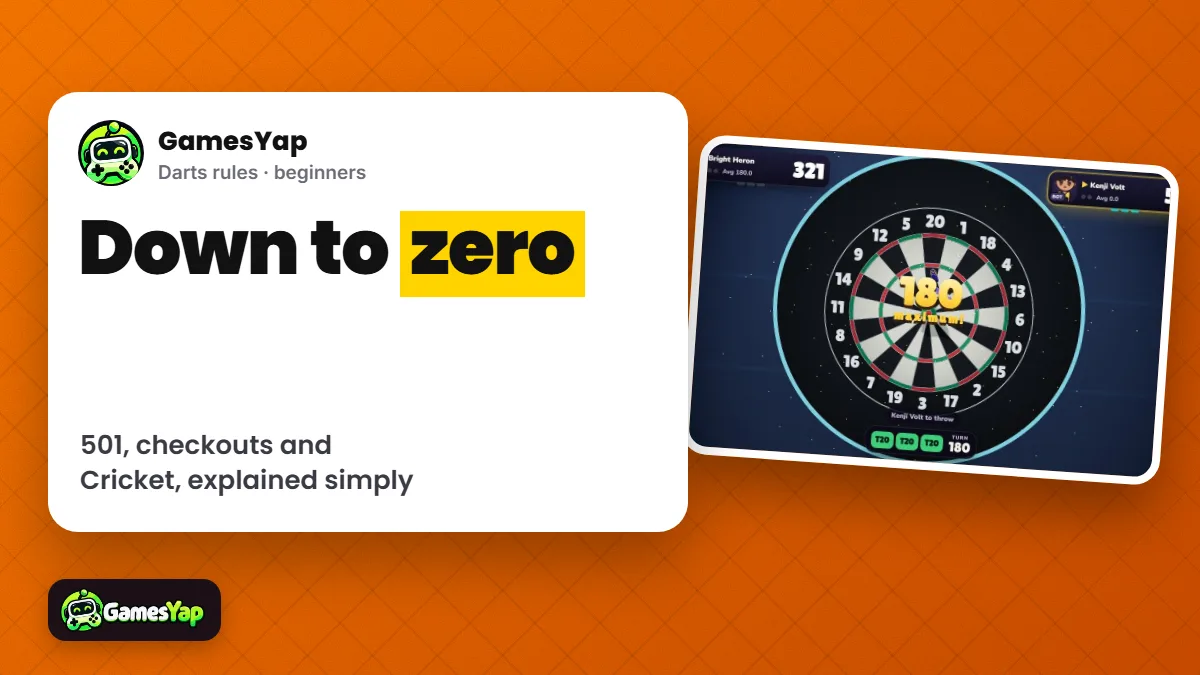
Darts looks simple: three darts, one board, aim for the middle. The scoring is what confuses most beginners, because the middle is not the best place to aim and the game is not about scoring the most points. In 501 you count down to exactly zero, and the last dart has to land in a thin ring at the edge of the board. Once that clicks, everything else follows.
This guide explains how the board scores, the rules of 501 and 301, how to finish a leg, and the other classic game, Cricket. You can try every rule as you read in Treble Rush, our free online darts game, which suggests a finish for every score and plays on a phone or a computer.
How the dartboard scores
The board is split into 20 numbered segments like slices of a pie. The numbers are not in order: 20 sits at the top, with 1 and 5 on either side of it, so a near miss of the 20 can cost you a lot. Each segment has four areas:
- The big single areas score the number itself.
- The thin outer ring is the double. It scores twice the number, so double 16 is worth 32.
- The thin middle ring is the treble. It scores three times the number, so treble 20 is worth 60, the most valuable spot on the board.
- The bull is the middle. The green ring around it scores 25 and the red center scores 50. The red center also counts as a double, which matters for finishing.
A dart that lands outside the doubles, in the black ring with the numbers, scores nothing. A turn is three darts, and the best possible turn is three trebles 20: 180, the score every player wants to hit.
The rules of 501 and 301
501 is the game played in most matches. Each player starts on 501 and takes turns of three darts. Whatever you score is taken away from your total, and the first player to reach exactly zero wins the leg. 301 works the same way from a lower start, so it is quicker and a good first game.
Most matches are played with double out: the dart that brings you to zero must land in a double or in the red bull. If you are on 40, a single dart in double 20 wins the leg; a single 20 leaves you on 20, and then you need double 10.
Then there is the bust. Your turn is canceled, and your score goes back to what it was at the start of the turn, if:
- you score more than you have left,
- you are left on exactly 1, which can never be finished on a double, or
- you reach zero with a dart that is not a double.
Busts are why good players count before every dart. Some casual games use straight out instead, where any dart that hits zero exactly wins, and Treble Rush lets you pick either rule.
A match can be a single leg or a set number of legs, such as best of 3 or best of 5. The player who throws first changes every leg so nobody keeps the advantage.
Checkouts: how to finish a leg
Finishing a leg is called a checkout. The highest checkout in 501 is 170: treble 20, treble 20 and the bull. A few scores between 159 and 169 can't be finished with three darts at all, so players try not to leave them.
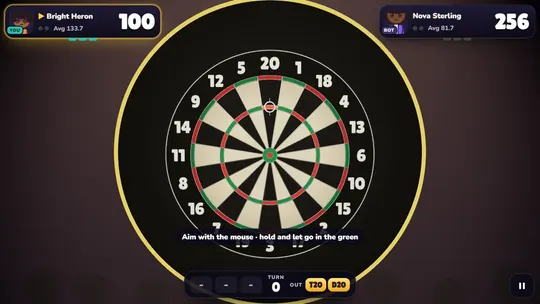
You don't need to learn a chart to start. A few habits cover most legs:
- Leave an even number. Every double is even, so an odd score needs one more dart to set it up.
- Love 32 and 40. Double 16 (32) and double 20 (40) are popular because a miss into the single often leaves another double: miss double 16 into single 16 and you still have double 8.
- Know the two-dart finishes. 100 is treble 20 then double 20; 60 is single 20 then double 20; 50 can be finished with the bull.
- Set up when you can't finish. On 41 with one dart, hit a single 9 to leave 32 rather than trying something risky.
In Treble Rush the bar at the bottom of the screen shows the classic route for your score and the darts you have left, so you learn the finishes just by playing.
How to play Cricket
Cricket is the other darts game you will meet everywhere, and it plays very differently. Only the numbers 15 to 20 and the bull count. The goal is to close each of them by hitting it three times: a single is one mark, a double is two marks and a treble is three. The outer bull is one mark on the bull and the red center is two.
Once you have closed a number, every extra hit on it scores points, but only while your opponent still has that number open. When both players have closed a number, it is dead and scores nothing for anyone.
You win when you have closed all seven numbers and you have at least as many points as your opponent. So Cricket is a tug of war: you can close numbers fast, or you can score on a number your opponent hasn't closed yet and force them to deal with it.
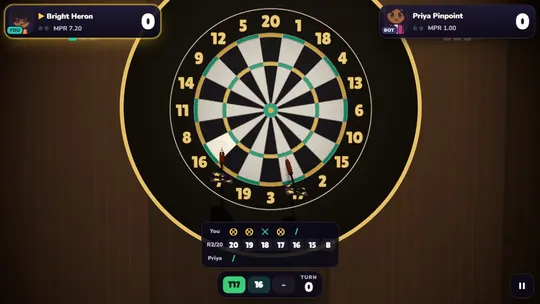
A simple plan for beginners:
- Start with 20 and work down, because higher numbers score more.
- If your opponent is scoring on a number you haven't closed, close it next.
- When you are behind on points, score on a number they still have open.
In Treble Rush, the marks table under the scores shows a slash for one mark, a cross for two and a circled cross for a closed number, and each leg ends after 20 rounds if nobody has finished.
How to aim better
Real darts and online darts share the same idea: steady hands beat strong arms. A few tips that work in both:
- Aim for the treble 20, but accept the 20. A big single area sits around the treble, so a small miss still scores well.
- Find a rhythm. Throw at a steady pace instead of rushing after a bad dart.
- Count before you throw at a double. Knowing what a miss leaves you is half of finishing.
In Treble Rush you hold a finger on the board to aim and flick up to throw, or hold the mouse button and let go when the meter is in the green. Your aim sways a little and settles after about a second of holding still, so the same patience pays off.
Where to practice
The easiest way to learn is to play. Treble Rush has Around the Clock for practice, eight computer players from beginner to champion, online matches against real players and a room code to play a friend. For more games like it, see our free sports games, the whole darts category or our list of multiplayer browser games to play with friends.
FAQ
What is the easiest darts game for beginners?
301 is the friendliest start. It follows the same rules as 501 but begins lower, so a leg is quicker and you reach the finishing part sooner. Around the Clock, where you hit 1 to 20 in order, is a good way to practice aiming at every part of the board before you play a full match.
Why do you have to finish on a double in darts?
Finishing on a double makes the end of a leg a real test of skill, because the double ring is thin and sits at the edge of the board. It also keeps players counting: you must plan a score that leaves a double. Casual games sometimes use straight out, where any dart that hits zero exactly wins.
What happens if you go below zero in 501?
That is a bust. The whole turn is canceled and your score returns to what it was before the turn, as if you had thrown nothing. You also bust if you are left on 1, or if you reach zero with a dart that is not a double when you play double out.
What is the highest checkout in darts?
The highest checkout in 501 with a double out is 170: two trebles 20 and the red bull, which counts as a double. A few scores just below it, such as 169, 168, 166, 165, 163, 162 and 159, can't be finished with three darts, so players try not to leave them.
Can I play darts online with a friend?
Yes. In Treble Rush you open Play a Friend, create a room and share the six-letter code or the invite link. Your friend joins from any phone or computer and you play 501, 301 or Cricket together. Every throw in an online match is judged on the game server.